


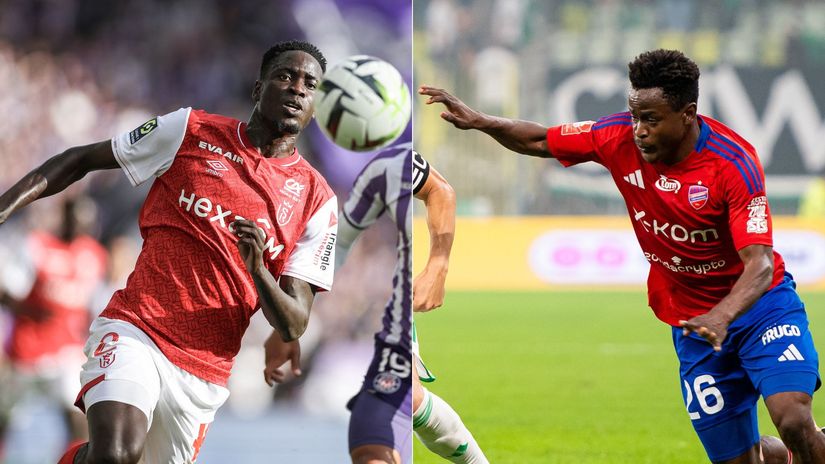
Joseph Okumu and Eric ‘Marcelo’ Ouma's influence on Kenyan transfers to Europe



.jpg)
.jpg)
Reading Time: 7min | Tue. 05.05.26. | 19:38
Have Okumu and Ouma’s performances helped position Kenyan players as viable options within structured European systems?
Kenya internationals Joseph Okumu and Eric 'Marcelo' Ouma have, over the past seven years, steadily built solid reputations in European football through their performances in Sweden, Belgium, France and Poland.
Download our Mozzart Sport app for more news
From Okumu’s development at IF Elfsborg and subsequent moves to KAA Gent and Stade Reims, to Ouma’s emergence as a key fullback at AIK and a later move to Raków Częstochowa, both players have demonstrated the tactical discipline and consistency required at that level.
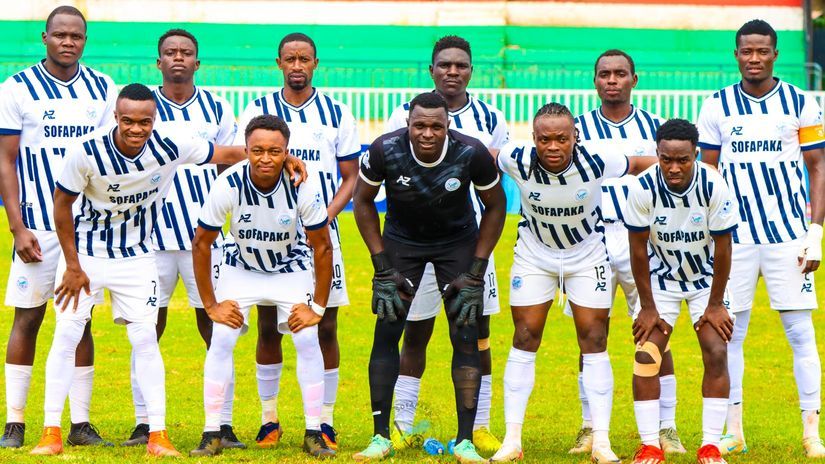
Their impact is now beginning to reflect in recruitment patterns. The recent move by Gent to assess Kenyan prospects, former Agai Mixed Secondary School defender Peter Brian, and former Musingu Scorpions forward Kevin Manani, who are currently in Belgium for trials, points to a growing confidence in the Kenyan talent pipeline.
This raises a broader question: have Okumu and Ouma’s performances helped position Kenyan players as viable options within structured European systems?
Establishing Credibility in Sweden
When Joseph Okumu joined Elfsborg in 2019, he entered a league that places a premium on structure, positional discipline and intelligent use of possession.
The Allsvenskan is not always the most glamorous destination, but it is unforgiving tactically. Defenders are expected to initiate attacks as much as they are to stop them.
AIK nära självmål när Erick Otieno nickar bollen tätt utanför egen stolpe 👀 pic.twitter.com/7eQcpUf2V3
— Sports on HBO Max 🇸🇪 (@sportshbomaxse) May 28, 2023
Okumu adapted quickly. His profile, left-footed, physically dominant, and calm in possession, fit seamlessly into Elfsborg’s build-up structure.
He became more than a defensive presence; he was an outlet, a release valve when opponents pressed high. In such moments, his decision-making carried weight. A misplaced pass could trigger danger, but consistency in execution built trust.
That trust is what elevated him. Coaches rely on predictability within systems, and Okumu offered exactly that. His ability to maintain line integrity while stepping into midfield spaces with the ball reflected a tactical maturity that challenged long-held stereotypes about Kenyan defenders being purely reactive.
While Okumu was establishing himself in Borås, Ouma was crafting his own identity at AIK. Nicknamed ‘Marcelo,’ a nod to the Brazilian fullback archetype, his game initially drew attention for its athleticism. Yet in Sweden, raw pace is rarely enough.
At AIK, Ouma’s role evolved. He became a modern fullback in the truest sense: advancing high to support attacks, but equally responsible for defensive balance.
His timing improved, his positional awareness sharpened, and his recovery runs became more calculated than instinctive. Over time, he turned into a dependable two-way player in a league that demands tactical accountability from wide defenders.
#Kenya’s Joseph Okumu scored his first goal of the season for French club Reims in the 2-1 home defeat vs Brest. pic.twitter.com/BVTWri5l6m
— Olúwashínà Òkélèjì (@oluwashina) October 28, 2024
In different ways, both players were answering the same question European scouts often ask: Can this player function within a system?
For Okumu, Sweden became a springboard rather than a destination. His move to KAA Gent in 2021 marked a significant step up, not just in profile but in tactical expectation.
The Belgian Pro League occupies a unique space in European football, a developmental ecosystem where players are refined for top-five leagues.

At Gent, the margin for error narrowed. Defensive lines pushed higher, pressing systems became more aggressive, and the speed of play increased.
Yet Okumu’s core attributes translated. His composure in possession allowed Gent to build from the back under pressure, while his reading of the game helped him adapt to faster transitions.
Perhaps more importantly, his exposure to European competition introduced him to a different level of tactical complexity. Facing varied styles, high-pressure teams, deep blocks, and transitional sides required constant adaptation.
DUKE ABUYA DOUBLES THE LEAD WITH A GREAT FINISH!!!
— Football Report (@FootballReprt) September 10, 2024
ERICK OTIENO WITH A SENSATIONAL PLAY FOR THE ASSIST!!!#AFCONQ2025 #AFCON2025Qpic.twitter.com/myV6d653yY
In meeting those demands, Okumu evolved from a reliable defender into a reference point.
For clubs operating within data-driven recruitment models, such consistency matters. It reduces uncertainty. It signals that a player from a previously underexplored market can integrate and perform within structured European systems.
Football scouting rarely operates in isolation. Success creates patterns, and patterns influence decision-making. In Elfsborg’s case, Okumu’s impact did not go unnoticed. The Swedish side returned to the Kenyan market, a move that would have seemed less likely without a successful precedent.
That pattern has broader implications. Kenyan players are increasingly being evaluated not just for their physical attributes, but for their tactical suitability. The question is no longer whether they can cope, but whether they fit.
Ouma’s trajectory reinforces that shift. His development at AIK demonstrated that Kenyan players can absorb tactical instruction and execute complex roles consistently.
For wide players, particularly fullbacks, this is critical. The modern game demands multifunctionality, and Ouma showed that such demands can be met.

Together, their journeys have begun to recalibrate perception. Kenyan footballers are no longer framed solely through athleticism. They are being assessed within the same tactical frameworks applied to players from more established pipelines.
The Expanding Kenyan Footprint
What began with individual success stories is now evolving into something more structured. The presence of Kenyan players at IF Elfsborg, AIK, and KAA Gent is no longer incidental; it reflects a growing pattern of recruitment shaped by performance, tactical fit, and institutional memory.
At Elfsborg, Joseph Okumu’s influence extended beyond his own performances. When the club moved to sign Timothy Ouma in 2022, it was widely viewed as a continuation of that trust. The midfielder arrived from Nairobi City Stars on a long-term deal, explicitly following in Okumu’s footsteps.
El 'Torito' @Casseres23 se preparaba para embestir 😩, pero Joseph Okumu tenía otros planes 😏 pic.twitter.com/DiJaRdp3Ym
— Ligue 1 Español (@Ligue1_ESP) October 23, 2023
At AIK, a similar cluster has formed, but with even greater visibility. Ouma became the anchor figure, but he has not been alone. The Stockholm club has, in recent seasons, hosted multiple Kenyan players simultaneously, including Stanley Wilson, Henry Meja and Collins Sichenje.
Meja’s move from Tusker FC in 2021 was particularly significant. As one of the most promising young forwards in the FKF Premier League, his transfer represented AIK’s willingness to invest in raw Kenyan attacking talent, not just developed defensive profiles.
Sichenje’s arrival a year later further reinforced that trend. His decision to join AIK was influenced, in part, by the presence and performances of fellow Kenyans already at the club, a clear indication of how internal references can shape recruitment decisions.

In Belgium, the Kenyan footprint at Gent predates Okumu, but his impact remains the most pronounced in the modern context.
Before him, midfielders John Muiruri and Robert Mambo Mumba had brief spells at the club in the early 2000s. However, Okumu’s tenure spanning over 90 appearances redefined the scale and significance of Kenyan representation at the club.
Unlike his predecessors, Okumu was not a peripheral figure. He became central to Gent’s defensive structure, featuring consistently in domestic and European competitions. That level of involvement carries weight in recruitment strategy. It transforms a nationality from a statistical entry into a trusted scouting channel.
Kenya’s Stanley Wilson Shines for AIK vs Brommapojkarna 🇰🇪 — His Take on the Inverted Fullback Role#AIK #StarsAbroad #KenyanFootball #Allsvenskan pic.twitter.com/4dLX6lpYgj
— Jeff Kinyanjui (@_JeffKinyanjui) April 18, 2026
Across these three clubs, a pattern is now visible.
At Elfsborg, the transition from Okumu to Timothy Ouma highlights continuity in profiling. At AIK, the simultaneous presence of Wilson, Ouma, Meja, and Sichenje illustrates depth in recruitment.
At Gent, Okumu’s success has elevated the ceiling for what Kenyan players are expected to achieve.
Taken together, these developments suggest that Kenyan players are no longer entering European football as isolated cases. They are increasingly part of a recognised pipeline, shaped by tactical compatibility, performance data, and crucially precedent.
What Okumu and Ouma have achieved extends beyond personal milestones. Their careers have contributed to a subtle but important shift in how Kenyan football is integrated into global scouting networks.
This is not to suggest that the pathway is now guaranteed. European football remains highly selective, and each player must still meet the demands of the system they enter. However, the barrier of perception, often the most difficult to overcome, has been lowered.

In practical terms, this means more opportunities, but also higher expectations. Kenyan players entering these environments are now measured against precedents that have already proven successful.