


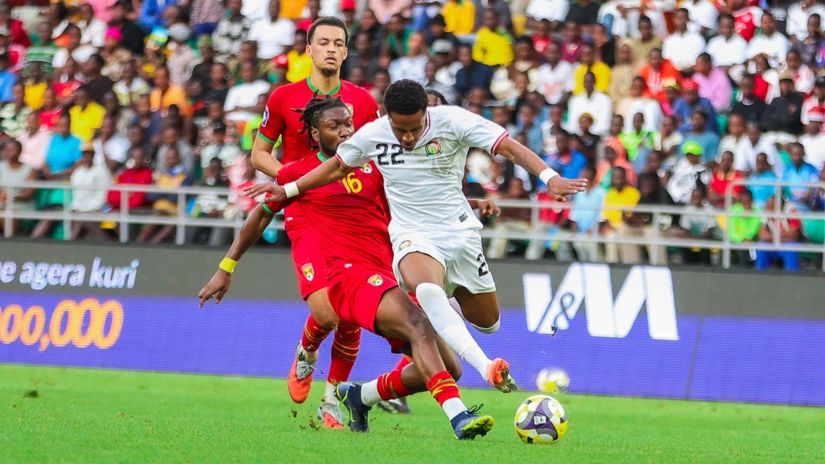
TACTICAL ANALYSIS: Harambee Stars' brilliant game plan that suffocated Grenada


.jpg)
Reading Time: 5min | Tue. 31.03.26. | 17:41
From the opening phases, Kenya imposed their identity through controlled build-up and dominance, while Grenada struggled to progress cleanly or sustain attacking phases
Kenya secured a commanding 3-0 victory over Grenada in a FIFA Series match defined by structural clarity, aggressive pressing, and intelligent use of width.
Download our Mozzart Sport app for more news
From the opening phases, Kenya imposed their identity through controlled build-up and dominance, while Grenada struggled to progress cleanly or sustain attacking phases.
Grenada set up in a structured 4-2-3-1, anchoring their shape around a disciplined double pivot of Parish Muirhead and Trevon Williams in front of centre-backs Greg Sandiford and Dorrel Pierre.
Fullbacks De Coteau Jabari and Josh Gabriel provided width from deeper areas, while the attacking unit was built to support a central focal point in Lucas Akins.
John Brown Shavon operated as the advanced midfielder between the lines, flanked by Frank Romar and Francis Jermaine on the wings, giving Grenada a balanced platform to combine centrally while still posing a threat in wide areas.
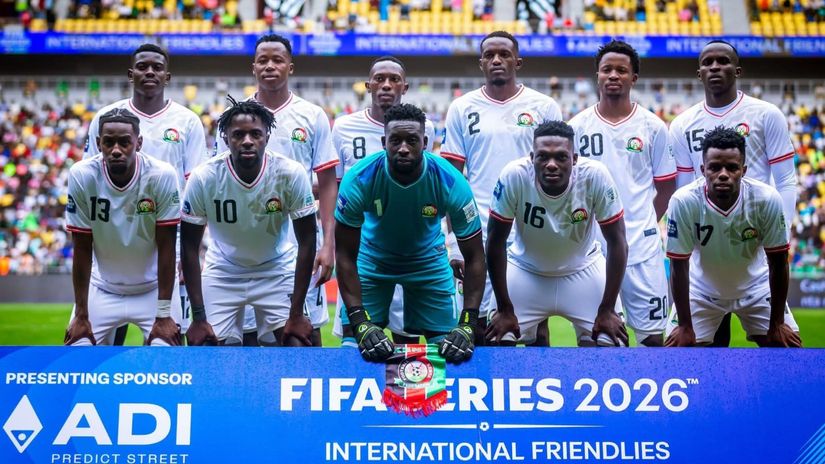
Kenya, in contrast, lined up in a more expansive 4-3-3, with a midfield trio designed to control central spaces and progress possession. Chrispine Erambo and Duke Abuya provided the base, allowing Austine Odhiambo to function as the creative hub ahead of them.
The back line of Ronney Onyango, Manzur Okwaro, Frank Odhiambo, and Mike Kibwage supported this structure, while the front three of Ben Stanley, Clarke Oduor, and Ryan Ogam offered width, pace, and vertical penetration.
The shape naturally created a midfield overload against Grenada’s double pivot, setting the stage for a contest defined by central control versus structured defensive stability.
Grenada sought compactness and transitional opportunities, while Kenya aimed to control possession and stretch the pitch horizontally.
Out of possession, Grenada initially adopted a mid-block with elements of man-orientation in midfield, attempting to disrupt Kenya’s central progression.
However, this defensive scheme soon became reactive rather than proactive, as Kenya’s positional rotations and passing tempo created constant decision-making dilemmas.
.jpg)
Kenya’s centre-backs initiated build-up with composure, circulating possession to draw Grenada’s midfield line forward before exploiting spaces in wider zones.
Kenya’s attacking structure was particularly effective in the wide areas.
On the left, Ben Stanley held width while overlapping support arrived from the full-back, creating 2v1 situations.
On the right, Ronney Onyango and Clarke Oduor combined to stretch Grenada’s defensive line.
These wide overloads forced Grenada’s back line to shift laterally, opening central lanes for Austine Odhiambo, who operated as a free advanced playmaker between the lines.
The first goal in the 12th minute stemmed directly from Kenya’s pressing and territorial pressure.
A high regain near Grenada’s defensive third led to Ryan Ogam’s shot that was parried, with Austine Odhiambo reacting quickest to convert the rebound.
This sequence highlighted Kenya’s counterpressing structure, where multiple players remained close to the ball after losing possession, ensuring immediate pressure and second-ball dominance.
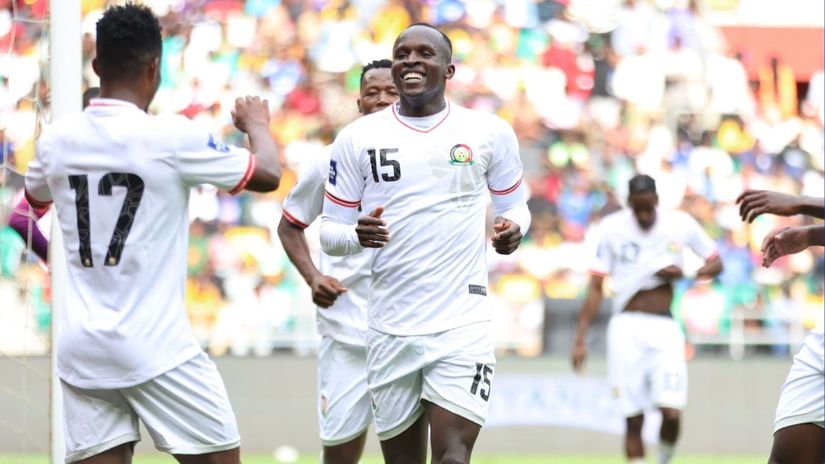
Just six minutes later, Kenya doubled their lead through a well-worked short corner routine. Instead of delivering into a crowded box, they manipulated Grenada’s defensive shape with a quick exchange, allowing Ryan Ogam to finish after a precise assist from Ben Stanley on the left.
This goal reinforced Kenya’s emphasis on structured attacking patterns rather than hopeful deliveries.
As the half progressed, Grenada retreated into a deeper 5-4-1 block, prioritising central compactness.
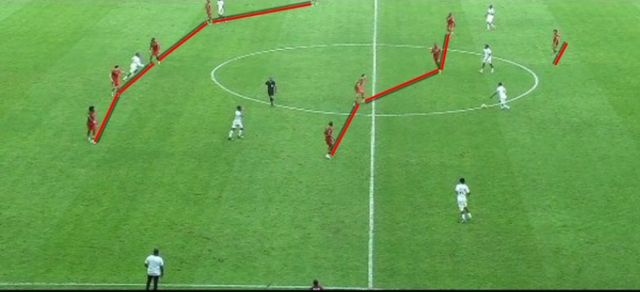
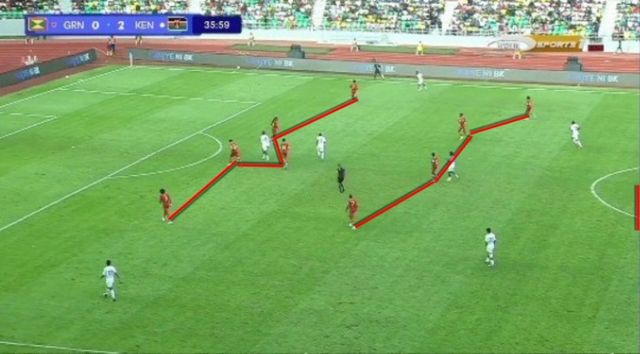
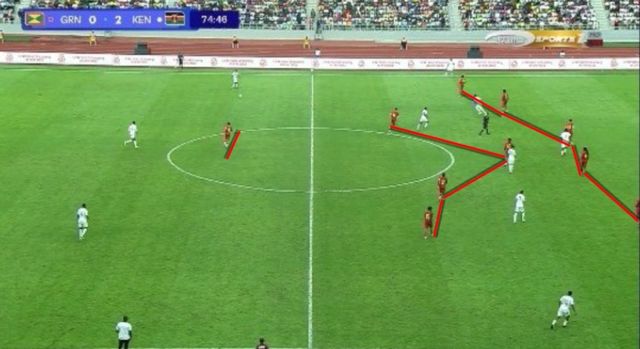
However, this shift only increased Kenya’s control.
By circulating possession patiently, Kenya forced Grenada’s defensive line deeper, creating space at the edge of the box and in half-spaces.
The advanced positioning of the left-back added another layer, forming overloads alongside the winger and central midfielder.
Kenya’s midfield trio played a crucial role in sustaining pressure.
Chrispine Erambo and Duke Abuya balanced defensive coverage with forward support, while Odhiambo consistently found pockets between lines.
Their rotations enabled third-man combinations, allowing Kenya to bypass Grenada’s midfield and access the final third with ease. Late runs from midfield, particularly around the 43rd minute, exemplified how Kenya attacked beyond the first line of pressure.
Defensively, Kenya alternated between a 4-4-2 mid-block and a high pressing structure.
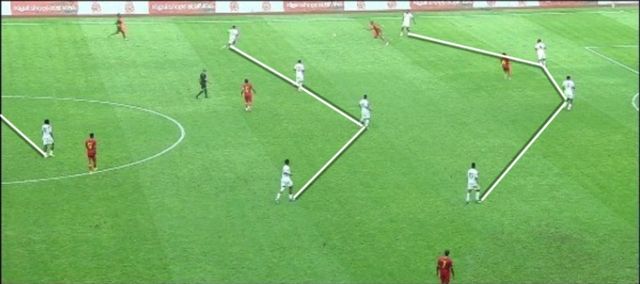
The front line initiated pressure with coordinated triggers, forcing Grenada into rushed decisions.
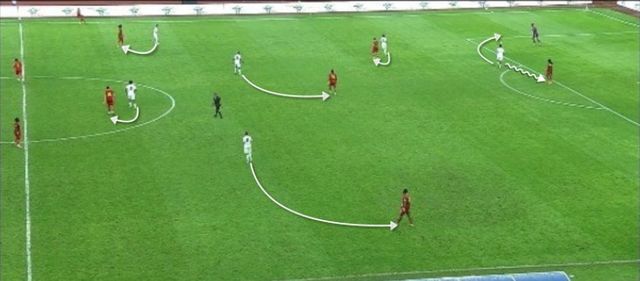
A high defensive line complemented this approach, catching attackers offside and compressing the playing space.
This dual approach ensured Grenada had neither time nor space to construct meaningful attacks.
The second half introduced tactical adjustments, particularly from Kenya, who made multiple substitutions without disrupting their structure.
Daniel Sakari, introduced at right-back, provided fresh energy and advanced positioning, often occupying the right half-space in addition to the flank.
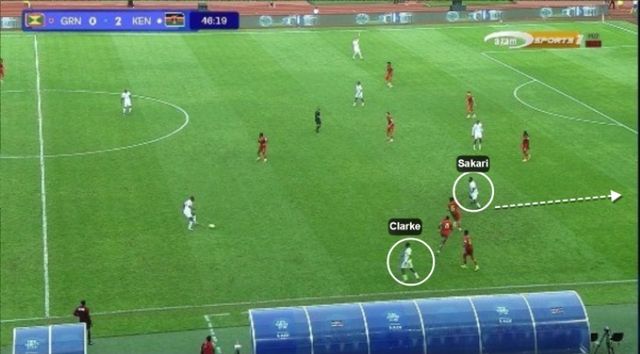
This added unpredictability to Kenya’s right-sided attacks, as rotations between Sakari and Oduor created new passing angles.
Grenada attempted to adapt by involving their striker deeper in build-up and pushing their right-back forward for width.
However, Kenya’s pressing remained highly effective. By directing play toward specific zones, they created pressing traps that forced long balls.
These were comfortably managed by Kenya’s defensive unit, which maintained strong spacing and aerial dominance.
Kenya’s attacking play in the second half emphasised combination play and triangular structures, particularly on the left side.
Interactions between the full-back, winger, and supporting midfielder allowed for fluid progression through tight spaces.
Third-man runs continued to destabilise Grenada’s defensive shape, while Odhiambo remained a constant outlet in advanced zones.
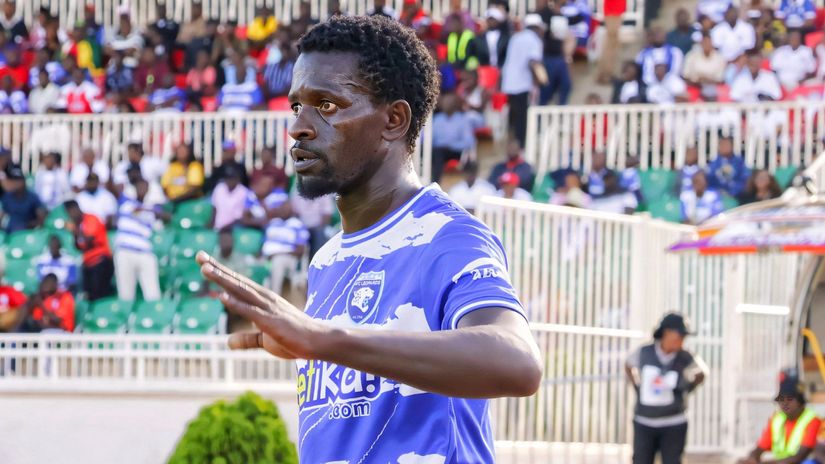
As the game entered its final stages, Kenya’s sustained pressure yielded a third goal in the 81st minute.
A well-constructed move involving hold-up play and a precise through ball culminated in a composed finish from Zech Obiero.
This goal encapsulated Kenya’s approach: structured build-up, coordinated movement, and clinical execution.
Throughout the match, Grenada oscillated between a 4-4-2 mid-block and a deeper defensive shape, but neither provided sufficient stability.
Their reliance on long balls in the second half reflected their inability to progress through midfield under pressure.
Kenya’s rest-defence structure ensured these transitions were neutralised quickly, preventing counterattacking opportunities.
In conclusion, Kenya’s victory was built on tactical cohesion and clarity across all phases. Their use of width, intelligent rotations, and aggressive pressing consistently exposed Grenada’s structural weaknesses.
By controlling both possession and transitions, Kenya dictated the rhythm and territory of the match.
This performance not only secured a 3-0 win but also demonstrated a well-defined tactical identity capable of dominating opponents through structure and execution.