


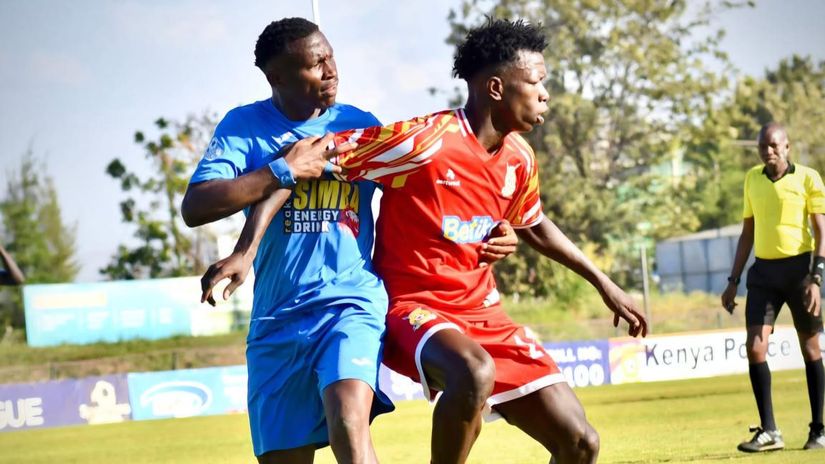
TACTICAL ANALYSIS: How Bidco's resilience frustrated Kenya Police in a 1-1 stalemate

.jpg)
.jpg)
.jpg)


Reading Time: 6min | Tue. 03.02.26. | 21:33
This analysis breaks down the tactical mechanisms that shaped the contest, from build-up structures and pressing schemes to late-game adjustments and decisive moments behind the defensive line
Kenya Police FC and Bidco United entered Monday's contest from contrasting competitive standpoints, but the tactical storyline that unfolded was one of territorial dominance versus game-state efficiency.
Police controlled possession, territory, and shot volume for long spells, while Bidco remained structurally disciplined, waiting patiently for moments to strike in transition.
Follow our WhatsApp channel for more news

The eventual 1-1 draw reflected not randomness, but a match defined by contrasting interpretations of control: Police through structure and spacing, Bidco through timing and vertical execution.
This analysis breaks down the tactical mechanisms that shaped the contest, from build-up structures and pressing schemes to late-game adjustments and decisive moments behind the defensive line.
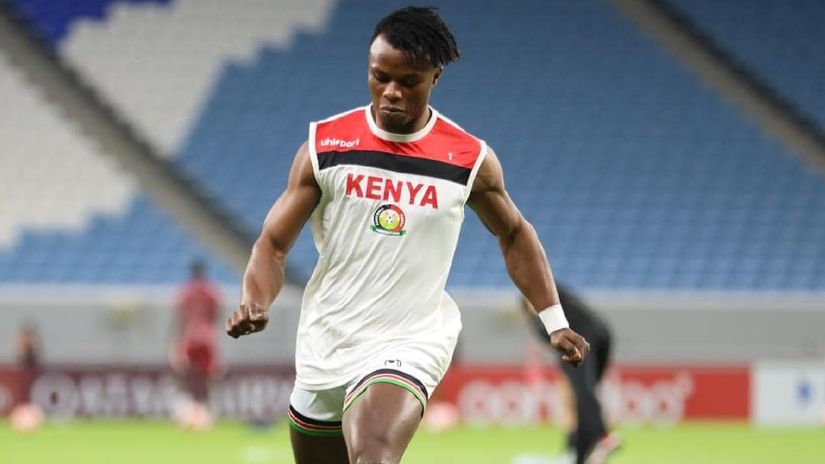
Kenya Police began in a 4-3-3 that was clearly oriented toward positional dominance. Job Ochieng operated as the goalkeeper behind a back four of Baraka Badi (right-back), Geoffrey Onyango (left-back), and central defenders Jacques Ndecket and Abud Omar.
In midfield, Nana Kusi Asante and Marvin Nabwire formed a double pivot responsible for circulation and stability, while Brian Chonjo operated as the advanced midfielder, drifting laterally and occupying pockets between Bidco’s lines.
Yves Koutiama led the line as a mobile striker, flanked by Albert Otieno on the right and Edward Omondi on the left.
Bidco United, by contrast, set up in a 4-5-1 that flattened into a 4-4-2 out of possession.
Issa Emuria started in goal, shielded by Francis Chege, Stephen Okola, Marvin Amuka, and Thomas Wainaina.
Michael Bodo anchored the midfield, with Christopher Raila and David Odoyo providing support, while Brian Mboya and Iddris Amadi alternated flanks.
Collins Akite functioned as the lone striker, tasked primarily with stretching the pitch vertically.

Police’s shape expanded aggressively in possession, while Bidco’s narrowed compactly without the ball.
Bidco’s defensive identity was built around a zonal mid-block with situational man-orientation in wide areas.
Out of possession, they dropped into a compact 4-4-2, protecting central corridors and forcing Police to circulate laterally.
Their priority was denying access between the lines, especially to Chonjo and Koutiama, while allowing wide progression under controlled conditions.
The pressing triggers were clear: lateral passes toward the flanks or back-passes to Job Ochieng prompted coordinated jumps, particularly from the near-side winger and central midfielder.
This scheme was not about winning the ball high, but about delaying Police’s rhythm and forcing them into predictable wide patterns.
Kenya Police’s build-up was methodical and structurally sound. In the first phase, Ndecket and Abud circulated possession patiently, with Marvin Nabwire/Nana Kusi dropping alongside them to form a temporary back three.
This numerical superiority allowed Police to bypass Bidco’s first pressing line and progress cleanly into midfield.
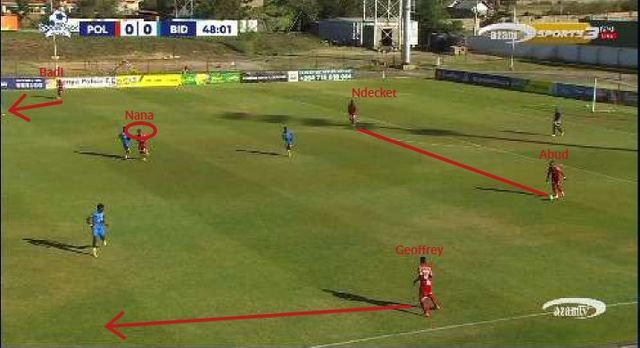
The full-backs, especially Geoffrey Onyango, positioned high and wide, stretching Bidco’s block horizontally.
Meanwhile, Edward Omondi frequently drifted into the left half-space or dropped deeper, dragging markers with him.
The cause-and-effect was consistent: Omondi’s inward movement pulled Bidco’s right-back inside, creating a wide channel for Onyango to exploit.
Chonjo’s lateral drifting further complicated Bidco’s defensive reference points, often creating temporary 3v2 overloads on the left side.
These rotations forced Bidco to constantly adjust their compactness, even though their overall shape remained intact for much of the first half.
The core weakness Police attempted to exploit was Bidco’s wide-to-central defensive shifting. Because Bidco prioritised central compactness, their wide defenders were frequently isolated once rotations drew midfield cover away.
Police repeatedly targeted this through cut-backs and low crosses rather than aerial deliveries.
Although no first-half goal arrived, Police’s five shots on target and 64% possession illustrated the effectiveness of their approach.
.jpg)
The goals were missing, but the patterns were consistent: overload wide, pull defenders out, then attempt penetrative passes through newly created gaps.
Police’s territorial dominance was most evident in the left half-space. Omondi, Chonjo, and Onyango consistently occupied staggered vertical positions, ensuring one player was always free between Bidco’s lines.
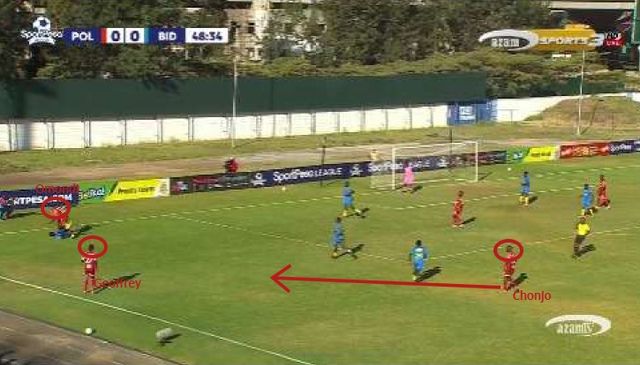
This spatial occupation forced Bidco’s right-sided defenders into conservative positioning, limiting their ability to step out aggressively.
The result was repeated access into advanced crossing zones and adjacent areas, even if the final action lacked precision. Bidco’s compactness protected the box, but at the cost of conceding control of the zones just outside it.
Out of possession, Kenya Police pressed in a 4-4-2 shape, with Koutiama dropping alongside Chonjo to lead the press.
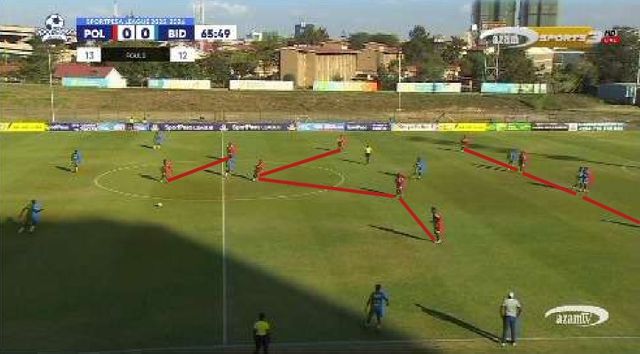
The objective was to force Bidco wide and then lock them into flank traps. Curved pressing runs prevented central progression, while the double pivot stayed close enough to contest second balls.
Bidco responded by using Issa Emuria to initiate long restarts, often targeting the right side to exploit transitional moments. While this reduced their ball retention, it aligned perfectly with their attacking intent.
Police’s rest-defence was structured around a 2-2 base behind the ball.

The centre-backs stayed compact, with Nana and Nabwire positioned close enough to counterpress immediately after possession loss.
This structure largely neutralised Bidco’s transitions in the first half, limiting them to one shot on target.
However, the high full-back positioning - especially Onyango’s - meant space existed behind the defensive line if the counterpress was bypassed.
The second half saw notable adjustments. Police intensified their left-sided focus, with Onyango overlapping more aggressively and Chonjo drifting left to overload that flank.
Bidco responded by delaying their press further and defending deeper, even dropping into a situational back five with Iddris Amadi retreating.
Bidco also increased their attacking ambition. David Odoyo found more freedom between the lines, while Akite began making sharper runs in behind.
After substitutions on both sides, Police shifted into a front two with Koutiama and Clinton Kinanga, seeking greater penalty-box presence.

The trade-off was defensive exposure. With numbers committed forward, Police’s rest-defence distances increased, reducing their ability to control depth.
When forced into a deeper block late on, Police remained compact centrally but struggled with recovery runs in wide-to-central transitions.
Bidco exploited this in the 84th minute, when Thomas Wainaina’s deep pass released Victor Kunyili, who finished with composure over the advancing goalkeeper.
.jpg)
Police’s response, however, underlined their persistence. By maintaining vertical threat and exploiting Bidco’s defensive line, Koutiama equalised in the 90th minute with a well-timed run and intelligent finish after Baraka Badi’s direct pass.
This match was a clear illustration of structural dominance versus transitional efficiency.
Kenya Police executed a coherent positional game, controlled key zones, and limited Bidco for long spells, but their inability to convert control into goals kept the game open.
Bidco, disciplined and patient, accepted territorial concession in exchange for high-value moments in behind.
The 1-1 draw ultimately reflected the tactical balance: Police’s structure dictated the match rhythm, while Bidco’s game-state management and vertical threat ensured they remained competitive.
Over a longer horizon, Police’s approach suggests sustainability, but refinement in final-third execution and rest-defence depth will be essential if control is to consistently translate into victories.