


TACTICAL ANALYSIS: How Gor Mahia can exploit Kakamega Homeboyz' frailties

.jpg)
Reading Time: 6min | Wed. 17.12.25. | 08:56
Gor Mahia will aim to stretch and manipulate the Homeboyz block, while the visitors will look to disrupt rhythm, exploit transitional moments, and capitalise on set pieces
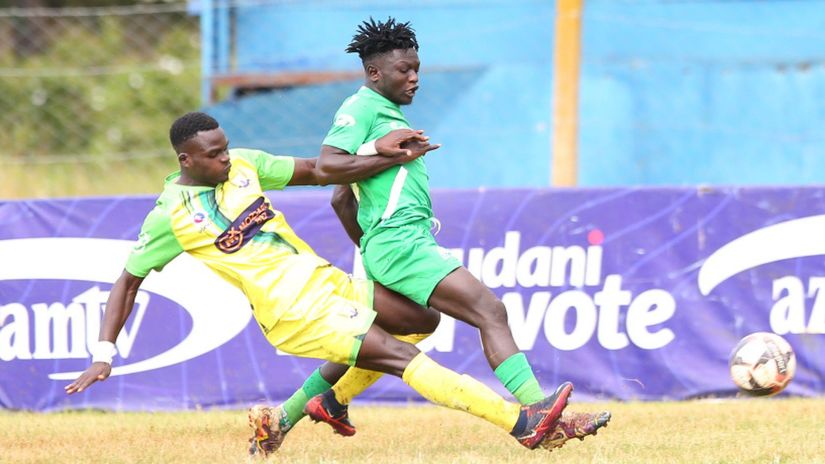
The FKF Premier League serves up one of its most iconic fixtures in recent history as Gor Mahia host Kakamega Homeboyz at the Kasarani Stadium, with the fixture slated for 1600 hours on Wednesday, 17 December.
K'Ogalo head coach Charles Akonnor knows the stakes are high, especially coming off a string of disappointing results, the major one being a loss in the Mashemeji Derby, a result that left a bitter taste in the Green Army faithful.
Homeboyz head coach Patrick Odhiambo, on his end, looks to exorcise the last-minute goal demons that saw him draw against Shabana FC at home.
Follow our WhatsApp channel for more news
.jpg)
In this pre-match tactical analysis piece, we set out to understand the game plans that both coaches will most likely employ and where the match could be won or lost.
Gor Mahia head into their encounter against Homeboyz with a clear intention to impose structure, rhythm, and territorial control, leaning heavily on the principles that have defined their recent performances.
Expect K’Ogalo to line up in their familiar 4-3-3, a shape that allows them to dominate central spaces while still stretching the pitch horizontally.
Bryne Omondi is set to marshal the goal, protected by a centre-back pairing of Sylvester Owino and Mike Kibwage, a duo valued more for their composure and distribution than sheer aggression.
The full-back roles are likely to be asymmetrical, with Paul Ochuoga at right-back encouraged to push higher and join the attacking line, while Bryton Onyona on the left provides balance by timing his forward movements more selectively.
This staggered backline structure is designed to ensure Gor Mahia can commit numbers forward without leaving themselves exposed in defensive transitions.
In the first phase of build-up, Gor Mahia will prioritise controlled possession, seeking to draw Homeboyz out of their defensive shell.
Enock Morrison’s role is pivotal here, as he is expected to drop between or alongside the centre-backs to create a temporary back three.
This movement not only provides numerical superiority against the first line of Homeboyz’ press but also opens passing lanes into midfield. Alongside him, Alpha Onyango offers physical presence and positional discipline, screening the backline while also acting as a metronome for circulation.
Together, the duo are tasked with managing the game’s tempo, switching play when pressure builds and ensuring Gor Mahia remain compact and protected against counterattacks.
As Gor Mahia progress into the middle third, their intention will be to establish midfield superiority through overloads and positional rotations. Austin Odhiambo, operating as the most advanced midfielder, becomes the key connector between lines.
Against a Homeboyz side likely to defend in a compact 4-1-4-1 or 4-5-1 out-of-possession shape, Odhiambo’s ability to drift into pockets, receive on the half-turn, and manipulate defenders will be crucial.
He is expected to act as the creative hub, threading passes with precision and varying weight and height depending on the movement ahead of him. His ball-carrying through pressure lines could also be decisive in destabilising Homeboyz’ block, especially if the visitors remain narrow and conservative.
Gor Mahia’s attacking patterns will place significant emphasis on wide progression and diagonal circulation.
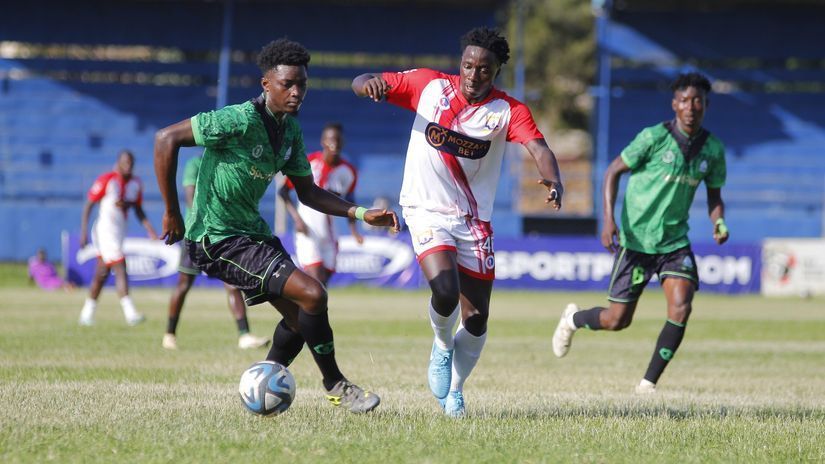
The centre-backs, supported by Morrison and Alpha, will look to switch play quickly, especially if Homeboyz attempt an aggressive high press.
Long diagonals towards Sharif Musa or Ebenezer Adukwaw are designed to exploit moments when the Homeboyz defensive line is unbalanced. This approach not only stretches the pitch but also forces the opposing full-backs into repeated defensive duels in large spaces.
Gor Mahia’s balanced use of width and depth could prove particularly troublesome down Homeboyz’ left side, where Boniface Onyango’s tendency to push high in attack can leave exploitable space in transition.
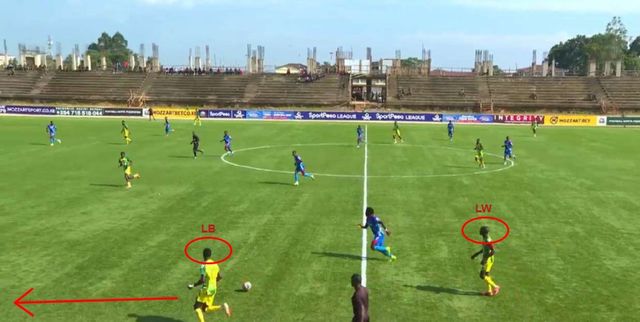 Kakamega Homeboyz’ LW Mudavadi drops deep, creating space for LB Boniface Onyango to surge forward on an overlapping run down the left flank.
That right-sided channel has already proven fruitful for Gor Mahia, as evidenced in their recent draw against Bandari, where Sharif Musa exploited space to deliver a decisive cross that Ebenezer converted.
Expect Gor Mahia to revisit this pattern, combining overlapping runs from Ochuoga with Musa’s directness to overload the flanks.
Ebenezer’s late runs into the penalty area will be a constant threat, especially if Homeboyz’ midfielders are dragged wide to assist their full-backs. These dynamics underline Gor Mahia’s intention to create high-quality chances through structured wing play rather than relying solely on central penetration.
Homeboyz, however, will arrive with a clear tactical identity of their own, shaped by their recent performance against Shabana. Defensively, they are well-drilled in stepping out aggressively once the ball is played wide.
Their full-backs do not hesitate to engage wingers early, preventing them from turning and forcing play into predictable channels.
This is complemented by midfielders stepping in to contest second balls, creating compactness around the ball.
While this approach can disrupt rhythm and limit time on the ball, it also leaves space behind the defensive line, particularly if the initial duel is lost or the press is bypassed with a well-weighted pass.
In possession, Kakamega Homeboyz show a tendency to overload one wing before quickly switching to the opposite side, aiming to attack before the opponent’s defensive block can reorganise.
Their left side, in particular, benefits from fluid positional rotations. Mudavadi often drifts from the left wing into midfield, allowing Hillary Juma to occupy the wide lane, while Boniface Onyango pushes forward from left-back to deliver crosses.
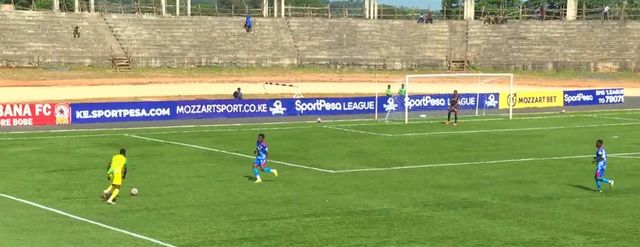 Boniface Onyango steps out of his left back role to exploit the width, advancing into the left channel with the task of delivering crosses into the penalty area
This coordinated movement maintains attacking structure while creating uncertainty for defenders tracking runners.
Against Gor Mahia, these rotations could test the discipline of Ochuoga and Onyona, especially if Gor’s midfield fails to provide timely cover.
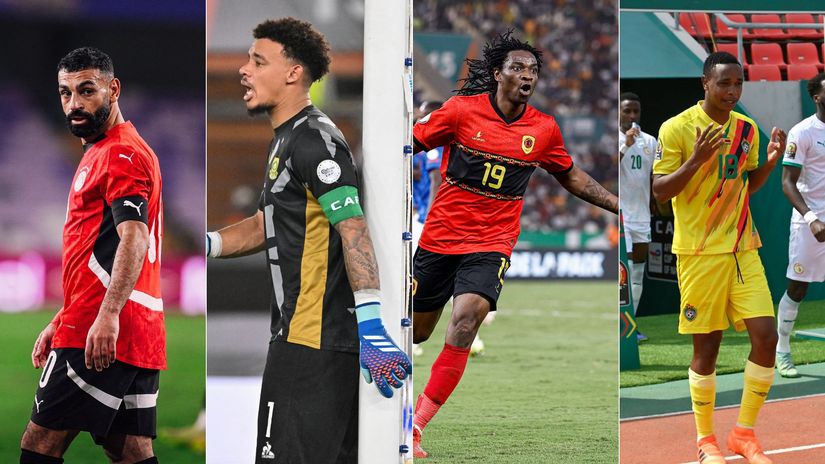
Homeboyz’ build-up is often designed to provoke pressure before going long, trusting their forwards to contest aerial duels and win second balls.
This direct element adds another layer to their attack, especially given their strength in attacking aerial deliveries from crosses, long throws, and set pieces.
Gor Mahia’s centre-backs will need to be alert and assertive in these situations, while Morrison and Alpha must be quick to collapse on loose balls to prevent sustained pressure around their box.
A key tactical nuance from Homeboyz is their game management after scoring.
They tend to adopt a more conservative posture, balancing risk and control, often retreating into a deeper defensive stance and absorbing pressure.
Against Shabana, this saw them spend long stretches of the second half defending reactively. While this approach can protect a lead, it also invites sustained attacks, something Gor Mahia are well-equipped to deliver through patient circulation and repeated switches of play.
Goalkeeping could also play a subtle role in shaping the match. Simon Masaka’s recent tendency to mistime runouts and uncertain claims under crosses presents a potential vulnerability.
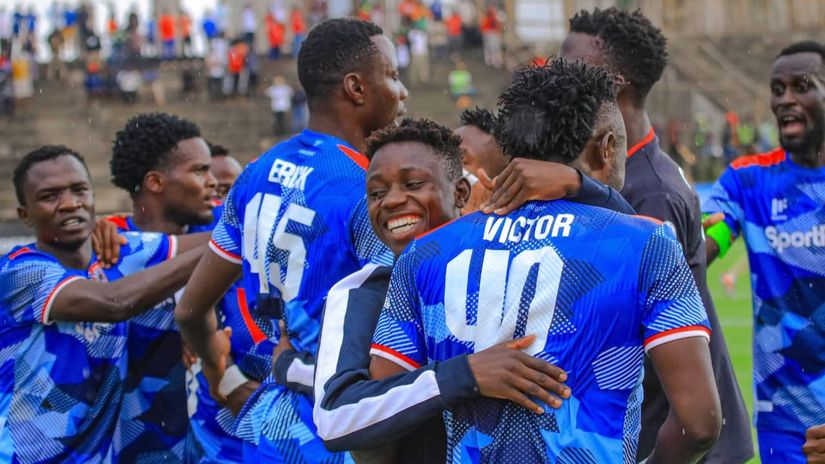
Gor Mahia’s emphasis on wide delivery and late box entries could directly test his decision-making, particularly if crosses are delivered early and with pace.
Ultimately, this fixture sets up as a fascinating tactical duel between Gor Mahia’s desire for control, structured possession, and wing exploitation, and Homeboyz’ compact defending, fluid wing rotations, and aerial threat.
Gor Mahia will aim to stretch and manipulate the Homeboyz block, while the visitors will look to disrupt rhythm, exploit transitional moments, and capitalise on set pieces. The outcome is likely to hinge on who better manages the wide areas and second balls, and which side imposes their tactical rhythm for longer spells of the match.