


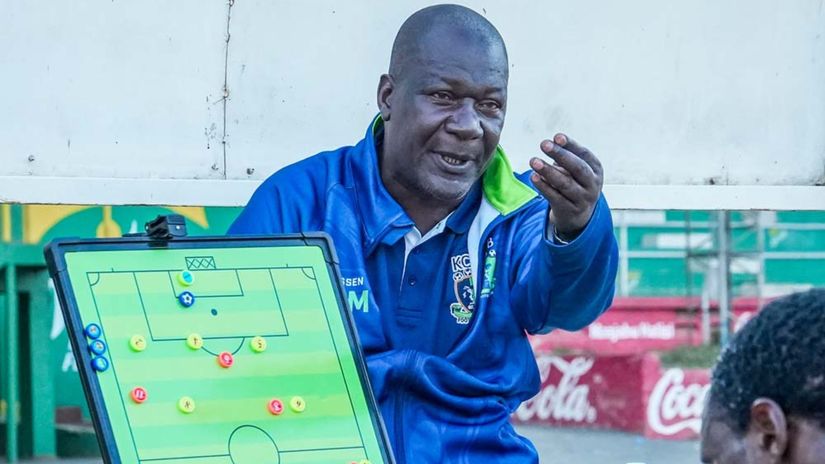
TACTICAL ANALYSIS: How Matano masterminded KCB's win over former employers Tusker


.jpg)




Reading Time: 4min | Sat. 20.09.25. | 17:16
KCB’s tactical clarity, superior organisation, and ability to transition quickly from defense to attack were the hallmarks of the day
KCB FC began their 2025/26 FKF Premier League campaign with a convincing 2-0 victory over Tusker FC at Kasarani Stadium on Friday, 19 September.
The win was significant not only for the three points but also for Robert Matano, who returned to Kenya after a short stint in Tanzania with Fountain Gate FC.
Against his former employers, Matano masterminded KCB’s third win over Tusker in the last seven years, setting an early marker for the Bankers’ season.

Follow our WhatsApp channel for more news
Team Shapes and Setups
Charles Okere deployed Tusker in a base 4-4-2 formation.
Joseph Ochuka started in goal behind a back four of Collins Odhiambo, George Kaddu, Charles Momanyi, and Alex Onchwari.
Denis Iguma and Issa Lumumba anchored the midfield, Cliff Oruko and Ian Simiyu occupied the flanks, with Erick Kapaito leading the line, supported by David Polepole.
Matano set up in a 4-2-3-1 structure for KCB.
Bonaphas Munyasa was in goal, shielded by Fadhili Masoud, Nashon Wekesa, Amatton Samunya, and Clyde Senaji.
Denis Maruti and Humphrey Mieno provided stability as the double pivot. December Kisaka and Bonface Omondi provided the width.
Richard Omondi and Kelvin Etemesi looked to alternate positions; however, Omondi played primarily behind Etemesi.

KCB’s Wing-Heavy Approach
KCB’s tactical focus was clear from the onset – defensive solidity with fullbacks holding their positions while wingers carried the creative load.
Kisaka and Omondi were key in stretching Tusker’s backline, often starting from deep positions to lure fullbacks out before accelerating into the vacated spaces.
The opening goal highlighted this approach. Kisaka deliberately dropped deep to drag Collins Odhiambo out of position.
Nashon Wekesa spotted the gap and fed the ball into space.
Kisaka’s burst of pace allowed him to beat Odhiambo, and his low cross was met by Omondi, who smashed home from close range.
KCB consistently sought to replicate this pattern, attacking in a 4-2-4 shape during forward moves.

The blind-side winger often tucked into the box alongside the striker and attacking midfielder, ensuring KCB had numerical superiority in central areas whenever crosses were delivered.
Tusker’s right side proved especially fragile.
The winger ahead of Odhiambo rarely tracked back, while the right centre-back failed to cover when Odhiambo was pulled wide.
KCB repeatedly exploited this channel, finding joy in transition and through direct wing play.
Tusker’s Offensive Structure
Okere’s Tusker also leaned heavily on wing play.
Oruko and Simiyu were the chief outlets, supported by Polepole and Kapaito, making diagonal runs to overload the flanks.
The plan, however, was neutralised by KCB’s defensive awareness.
The Bankers’ fullbacks pressed aggressively, denying time and space, while midfielders ensured Kapaito and Polepole were shepherded away from dangerous zones.

Frustrated, Okere made a first-half adjustment, replacing Oruko with Thomas Omole.
The winger’s raw pace and direct style forced Kisaka to drop deeper in support of his fullback, reducing KCB’s attacking width on that flank while giving Tusker a foothold.
Still, KCB’s compact defensive organisation limited the Brewers’ ability to create clear chances.
Second-Half Adjustments
KCB entered the second half with a more conservative approach, prioritising game management and quick counterattacks.
To freshen his side, Matano introduced Stephen Etyang for Kisaka, ensuring the team maintained speed and energy on the wings.
He also replaced Maruti with Jack Ong’aya, a more progressive midfielder capable of carrying the ball through transitions.
.jpg)
Ong’aya’s introduction allowed KCB to escape pressure more efficiently, turning defense into attack with long carries.
Tusker tried to push higher up the pitch in search of a breakthrough, but KCB’s discipline in their defensive block and their ability to spring forward in numbers ensured the Brewers remained on the back foot.
The Bankers ultimately managed the closing stages with maturity, sealing the 2-0 victory.
The Tactics of the Day
This match was defined by wing-oriented strategies, but KCB executed theirs with greater precision and discipline.
Matano’s decision to restrict his fullbacks and channel creativity through wide areas provided both defensive stability and a potent offensive outlet.
The use of Kisaka and Omondi to manipulate Tusker’s defensive structure proved decisive, particularly in creating the first goal.
Tusker, despite promising wing play of their own, were stifled by KCB’s proactive fullbacks and compact midfield, which denied their attackers space to operate.
Okere’s adjustments brought some improvement, but they lacked the penetration needed to trouble KCB’s backline.
Ultimately, KCB’s tactical clarity, superior organisation, and ability to transition quickly from defense to attack were the hallmarks of the day.
It was a performance that not only earned them three points but also underlined Matano’s enduring reputation as a master of pragmatic yet effective football.