


 S. Ochieng
Amon Wamalwa - Shujaa youngster savoring second chance at rugby after surviving heart surgery
.jpg)
.jpg)
.jpg)

Reading Time: 17min | Mon. 11.07.22. | 11:01
This is Wamalwa's story of resilience and making a comeback to rugby at a time when a heart condition threatened to kick the Homeboyz prodigy completely out of the game.
A flip through Amon Wamalwa’s social media pages and his early morning WhatsApp status updates introduces one to a myriad Bible verses.
“I can do all things through Christ who strengthens me,” reads a caption on his Twitter bio.
“I will give thanks to you, LORD, with all my heart; I will tell of all your wonderful deeds,” another post with his action picture follows just below.
“For with God, nothing shall be impossible,” reads his very latest post on Twitter as he poses with accolades he scooped at Dala 7s.
For with God nothing shall be impossible 🤲.
— Amon Wamalwa (@wamalwa_amon) July 4, 2022
What a time to be alive!🙏
Top point scorer 🏆
Top try scorer 🏆#dala7s
Thank you HomeHomeboyz RugbyThank you my teammates❤️ pic.twitter.com/OMYunaEPA3
The posts open a spiritual gate to the kind of life the 21 year old Shujaa youngster lives.
Considering everything he has gone through in his few years on earth and brief rugby career, a solemn picture of reverence and gratitude is painted by an athlete who immensely feels lucky to be playing the sport he is madly passionate about – rugby.
Back in 2021, Wamalwa’s hard work and persistence on the pitch seemed to have started paying off, eventually.
Having endured two years of disappointment in 2018 and 2019, the versatile player who revels either as a fly-half or a full back in the 15s game, got another call up to the junior national rugby side, Kenya Chipu, and was on hand to make his debut in national team colours in the 2021 edition of the continental U20 Barthes Trophy that was being held at the Nyayo National Stadium in Nairobi.
Simply put, Wamalwa was buzzing! Little did he know what was to come.
Initially, the youngster had failed to make the final Chipu squad in 2018 and despite being called up in 2019, the prodigy, who plies his trade at Homeboyz RFC, watched on from the benches in that year’s edition due to stiff competition.
So when he got another chance in 2021, the stars had seemed to be finally aligning for the youngster.
That time, around June, the tournament was making its comeback after the 2020 edition failed to take place due to the novel coronavirus pandemic that had ravaged the whole world. Due to the health uncertainties and travelling challenges, only three teams would feature then – hosts and eventual champions Kenya, Senegal and Madagascar.
Here are the Senegal U20 and Kenya U20 Captains.
— Kenya Rugby (@OfficialKRU) June 25, 2021
Photos taken at Brookhouse School where the teams are staying throughout the #BarthesTrophyNairobi
Enjoy the first match tomorrow from 4:00pm as #Chipu takes on Senegal live on @K24Tv pic.twitter.com/DodwAOV2ii
Wamalwa had been named as a fly-half in the starting 15 by head coach Curtis Olago for the opening match against Senegal.
And so on Friday night, just hours before the clash on Saturday afternoon, and at the height of what was supposed to be his breakthrough moment, calamity struck!
“We were doing our captain’s run by the way on that Friday. I had made the matchday squad against Senegal and I was included in the starting team as the fly-half. Normally, we have to do an electrocardiogram (ECG) test before taking to the pitch the next day. So we did it during the captain’s run,” Wamalwa narrates to Mozzart Sport overlooking the RFUEA Grounds at Ngong Road after a practice session.
🇰🇪 @wamalwa_amon
— Homeboyz Rugby (@HomeboyzRugby) June 15, 2021
🇰🇪 @OnzereArnold
🇰🇪 Reinhard Ngaira
Massive congratulations to three of our Boyz who have been selected to represent @OfficialKRU Under-20s in the upcoming training camp. All the best Boyz! #TheBoyzAreInTown pic.twitter.com/LGekeK4qZJ
An ECG is a simple test that can be used to check your heart's rhythm and electrical activity. Sensors attached to the skin are used to detect the electrical signals produced by your heart each time it beats. They detect heart problems by measuring the electrical activity generated by the heart as it contracts.
“The cardiologist came and did the tests for everyone. At around 9PM, when the results came back, I was called first and isolated,” the player reminisces with a forlorn look clouding his face.
“We are sorry, but you cannot play tomorrow,” the cardiologist dropped the bombshell.
“What?” a shocked and equally confused Wamalwa retorted.
“We have found you with a heart abnormality,” the cardiologist responded.
“But I have been playing rugby like this all my life since I was seven and I have never had any problems before,” an exasperated Wamalwa rebutted with balancing tears.
“You cannot play the game tomorrow. And if you want to play rugby again, you will have to undergo a surgery procedure,” the cardiologist firmly told him.

In a moment, the 21 year old instantly felt as if the room was too small, with not enough air coming in. His whole world came crushing on him and he was too small to bear the weight it came with.
He wanted to pass out, to unhear what the cardio just said to him. To be told the results at least a day after his debut for the national team. But it was not to be.
Everything he wished for could not happen, so he reacted the best way he knew. He cried for the whole night without wanting to talk to anybody. No food, no nothing! He had reached his end, at least he thought.
It is one of the significant moments in his young career that he says he will never forget and that has truly shaped him to what he is now and to what he wants to become as he soldiers on.
Eight months after his career threatening ordeal that had required surgery to correct, Wamalwa, who continues to earn raving reviews about his performance, became a hit in the country when, on his debut to the national men’s rugby 7s team - Shujaa -, he scored two out of the three tries that helped the very shaky side book their place in the 2022 Rugby World Cup Sevens that is set to take place in South Africa from 9-11 September.
I am so happy for Amon Wamalwa who scored 2/3 tries that sent Shujaa through to the World Cup Sevens.
— Ochieng' Stephen (@soo_ochieng) April 24, 2022
In August 2021, he had heart issues that needed corrective surgery and 8 months later, he sends Kenya to the WC on his debut to the national side!
What a story👏 #Kenya7s pic.twitter.com/KVtMTSm0J7
Who says a heart condition has to put you down? This is his story of resilience, making a comeback and being eternally grateful anytime he steps out there to play because in another situation, he would have been forced to cut short his promising career.
Starting Out
Wamalwa had just been a normal boy at the time. Born on 20th October 2001 in Githogoro, Runda area, Kiambu.
He had not grown up loving rugby like those celebrated superstars who tell us they started singing when they were one and a half years old. No.
Wamalwa loved football. And with his thin frame, never did it cross his mind that he could ever get into that deadly physical game they call a sport. Up until the inevitable fate knocked on his door.
“I was really young at the time, around 8 years, but I clearly remember when I made my first interaction with the sport. I used to love football, but my big brother, Boaz Wangila, was playing rugby. So, on one of his training rendezvous, I just escorted him to watch,” Wamalwa recalls.
.jpg)
For the Shujaa debutant, only a couple more visits alongside his brother was enough to pique his interest in the game as he started stifling his footballing passion.
“One day, out of curiosity, I asked my brother if I could even play rugby with such a small body. He really convinced me into it because he was so positive and quashed the talk about needing to have a big body,”
“Size does not always count in rugby. It is your passion and ‘heart’ that matters in the game,” Wangila offered a response to his small brother.
.jpg)
Just like that, an excited eight year old Wamalwa, who only had his brother’s assurance as his only shield, was fully convinced and started training with Runda Rugby Club which coincidentally happened to be in his neighborhood.
“I started playing rugby in the under 10 category being organized by the Community Rugby Association which was aided by the Rugby Patrons Society (RPS). I then played the sport in primary school because it was being offered courtesy of RPS,” he further narrates.
Amon Wamalwa @wamalwa_amon is a product of the Rugby Patrons Society Grassroots Programme.
— Rugby Patrons (@RugbyPatrons) July 5, 2022
He was selected for the Kenya U20 Rugby squad in early 2021 ahead of the Rugby Africa Bartez U20 Trophy event held at Nyayo Stadium in April 2021. pic.twitter.com/FYiAmdzc1f
That solid and early rugby foundation in Wamalwa’s life marked the start of what was to come. But beforehand, it had not been smooth sailing for the kid who had plunged himself in the sport wholeheartedly.
His parents, just like most Kenyan parents, if not all, had never vouched for their kids to go the sports way, worst of all, to get into the physical game.
“Playing rugby was forbidden in our family. My mum and dad were adamant that it was dangerous and did not want us anywhere near it. So in the early days we used to sneak whenever we went to play. There was a time they found out at some point and we were given some proper beating of our lives together with my brother,” Wamalwa reminisces with a smile.
But despite the restrictions, Wamalwa’s heart had already been set. And there was no way he was going to change his course for a second time. Already, he had killed his fizzling footballing dream for rugby. So he continued doing what he had to do to play the game - sneaking.
Eventually though, as fate would have it, one of Wamalwa’s bright displays warmed up their parents to the sport after their last born son came back home with a Most Valuable Player (MVP) Award from the U10 category.
Additionally, Carol Lloyd and John Lloyd (Runda Rugby Association sponsors) struck the iron while it was still hot as they came and talked to Wamalwa’s parents immediately after, convincing them how rugby could open opportunities for their fourth child.
.jpg)
Seeing the MVP award, their son’s utter resolve and the serious sponsors who made a point to seek their approval, the parents said yes. Wamalwa and his brother getting the liberty to play without hiding anymore.
After finishing his primary studies, Wamalwa took his talents to high school where his undeniable and enviable skills coupled with his solid rugby knowledge and foundation immediately took off.
“I remember I made the rugby school team at Muhuri Muchiri High School when I was in form 1. People were surprised because a form 1 was not expected to make it to the team,” the youngster says.
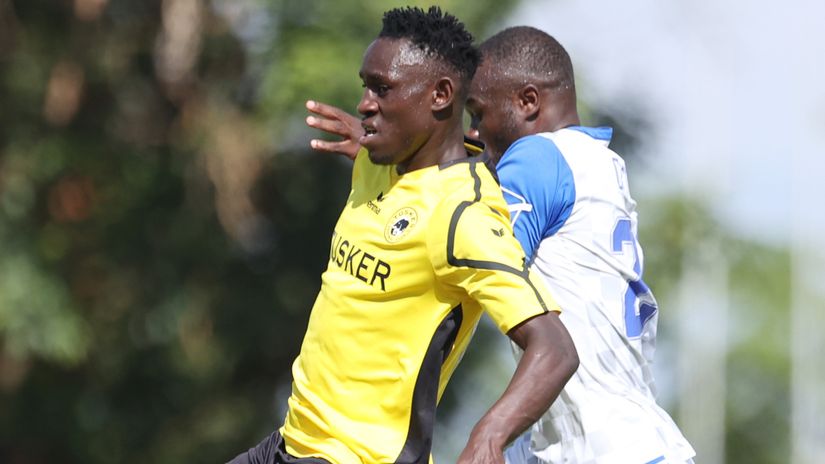
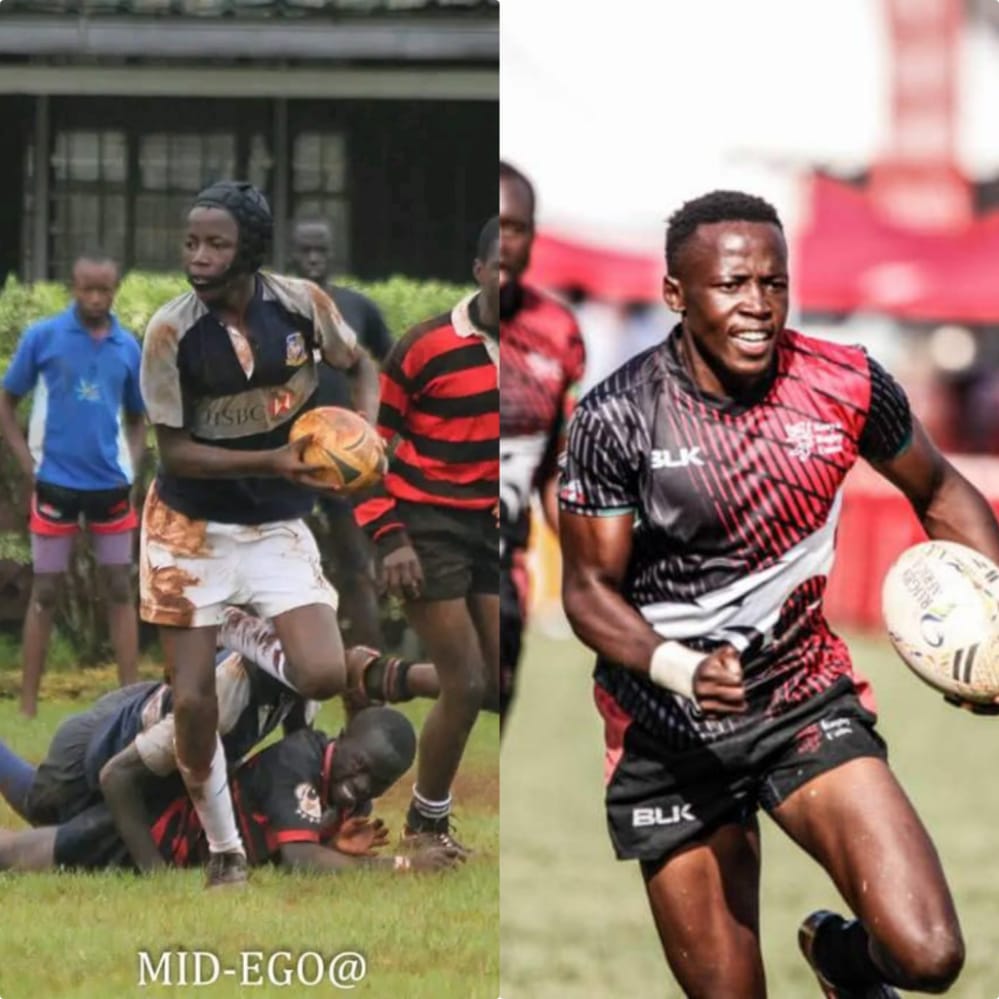
But he did. And with high school being a time where a lot of testing goes on in teenager’s lives, Wamalwa, who is nicknamed ‘Injes’ (short name for injera) as a result of his admiration of Shujaa’s all time top scorer Collins Injera, clearly remembers why he stuck to rugby.
“When I was in form 1, I got an award in school which encouraged me a whole lot. We used to play at the county level, metropolitan then nationals. At the time, I remember I scored two tries to send our team to the nationals in place of the feared Upper Hill whom we knocked out. That earned me the Sportsman of The Year Award in form 1,” he recalls.
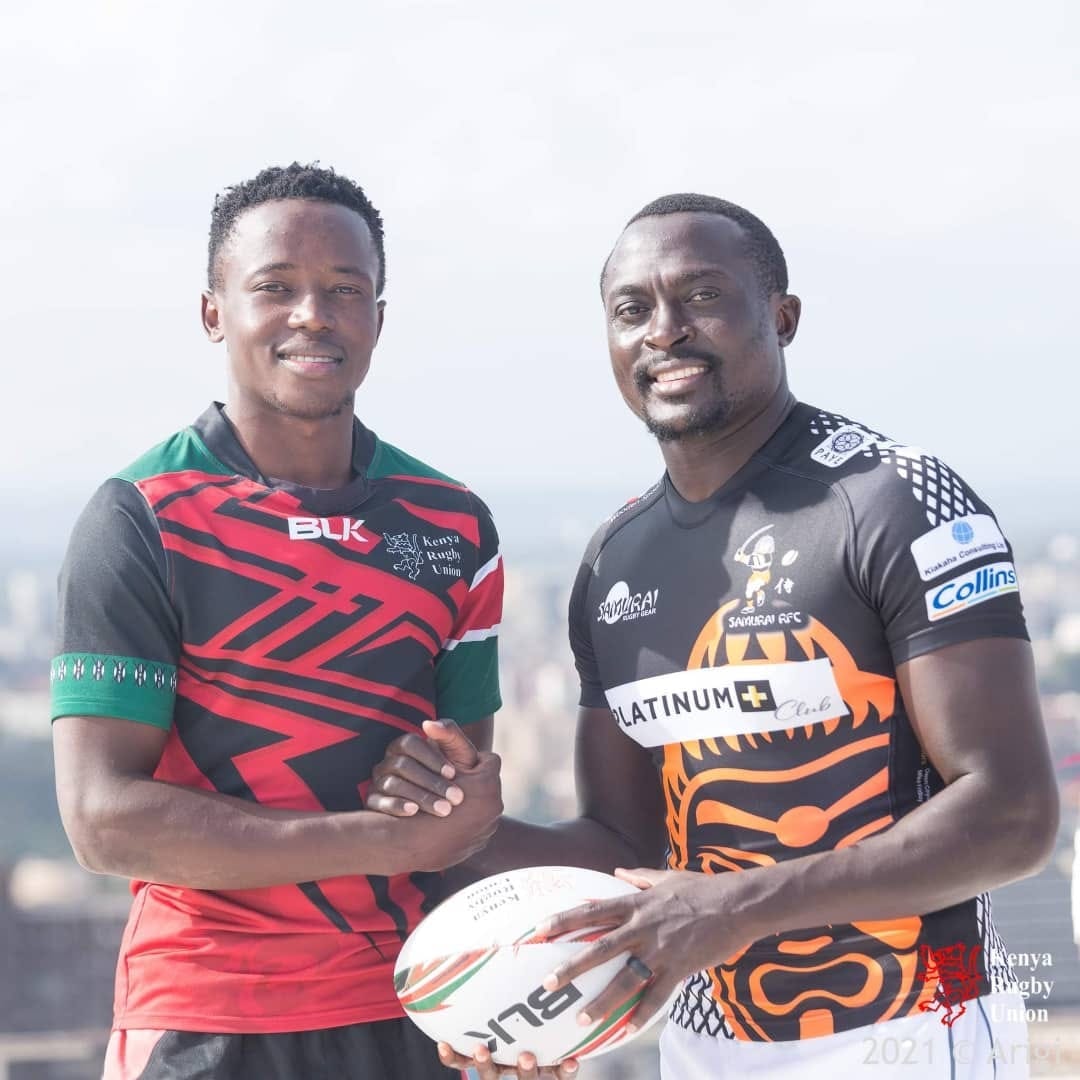 Wamalwa poses with Injera before the 2021 Safari 7s.
While it was a big achievement for the budding Injes, that would not be the only award lacing Wamalwa’s path. Infact, a whole lot more was to come, bigger and better!
“In 2017, when I was in form 4, I won the Most Valuable Player at the East Africa Games held in Uganda when we won the 7s tournament. We had qualified for the Games after finishing 3rd at the national level. In Uganda, we went all the way in the East African Games and won 14-7 against SS Jinja where I scored the match winning try,” the youngster says.
.jpg)
His roll of honors continued as he was named the Nairobi County Sportsman of the year 2017 for carrying his side to the East African games. His exploits in Uganda earned him a nomination for the 2017 SOYA Award (Most Outstanding Player of the Year) where he finished third as his high school team won the school team of the Year (Boys).
“Muhuri Muchiri rugby sevens’ fly half Wamalwa was the force behind Muhuri Muchiri’s sevens rugby success at the East Africa Games. Wamalwa captained his side, leading them to the memorable victory on their debut at the regional games. He was voted the MVP at the East Africa Games,” read a 2017 publication on the Nation.
.jpg) Wamalwa in action in a past game.
Wamalwa in action in a past game.Having already given enough glimpses of the talent that lay underneath, Injes started attracting attention in the rugby circles with clubs chasing to win his signature while he was still in high school. It is Homeboyz, however, who managed to win the race in landing the prodigy.
“I started club rugby with Homeboyz when I was in form 3. When we closed school, I used to play for them in the Eric Shirley Shield tournament - a second tier competition - until I finished school. Their then head coach Paul Murunga, Simon Odongo and chairman Mike Rabar had approached me during the national games and told me to join them. So that is how the journey started,” he says.
It is from there, where Wamalwa started laying inroads in his dreamy pursuit of donning a national team jersey. He thought 2018 would be his year after his SOYA nomination and after emerging the Most Valuable Player in East Africa. But it was never to be as he failed to make the final squad.
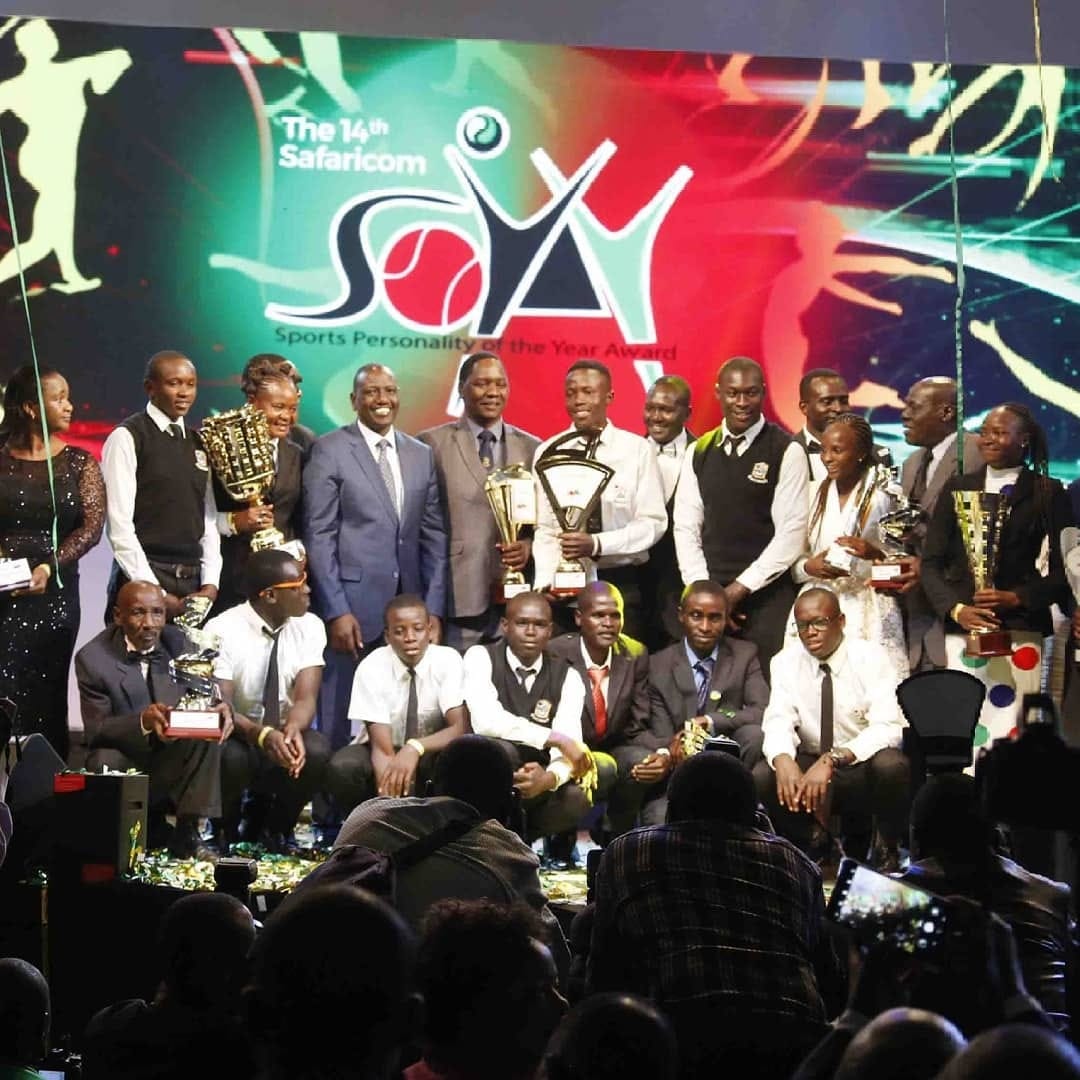
2019 also did not quite happen for him because of the level of competition that saw him only watch from the benches, this time after making the final squad.
“I really felt bad during the two occasions but I did not give up. I just went back and worked hard because there was someone better than me during that time in 2019,” the youngster acknowledges.
Unfortunately, the U20 Barthes competition was not held in 2020 due to the novel coronavirus pandemic, so when this heart complication ruled out Wamalwa out of the returning 2021 edition where he had made the starting squad after a wait that extended over three years for a maiden debut, Wamalwa was lost for words.
At that time he was 20 years old, the last time he was supposed to play in the junior category. And here was this heart condition threatening to take all his years of hard work down the drain.
“This had been the time I was waiting for all my life and then I am told I cannot play. I remember I cried the whole night in our camp at BrookHouse without wanting to talk to anyone. I felt really bad. I could not believe what was happening. But I had no option.
After a while, I just had to accept it and consoled myself that probably God had a reason as to why I should not play. The team manager also helped by talking to me to just face the reality. I had to undergo that surgery if I wanted to play rugby again,” a downcast Wamalwa regales.
For I know the plans I have for you , declares the LORD , plans to prosper you and not to harm you , plans to give you hope and a future ❤️🙏 Jeremiah 29:11
— Amon Wamalwa (@wamalwa_amon) August 23, 2021
Road to recovery 💪 pic.twitter.com/2lcNmHHPbB
The first problem was that Wamalwa felt his dream was almost being shuttered due to the heart condition. The second was that the only way to remedy the situation, through the surgery, was also too expensive for him and his family to manage.
Coming from a humble background, the cost of the surgery, estimated to be slightly over 1 million, threatened to kick Wamalwa out of the sport completely since there was no way they were going to afford that sum.
That moment also brought back all their parents fears because they never wanted them to play rugby in the first place saying it is a dangerous sport. So when Wamalwa developed the anomaly, those worst fears were confirmed as they started blaming all the occurrences on rugby.
“In my head I was wondering how I would even tell my parents about it because it was too expensive. And when I did, they said it was too much for them to pay. It even brought memories of their initial resistance for us to play rugby. They solely blamed it on the dangers of the sport. That that situation would not have happened had I not been playing the game. They kept insisting that when I was born I did not have any anomaly like that,” he offers.
At the back of his mind though, Amon knew it was the frustrations of raising the hospital bill that sent his parents ticking off.
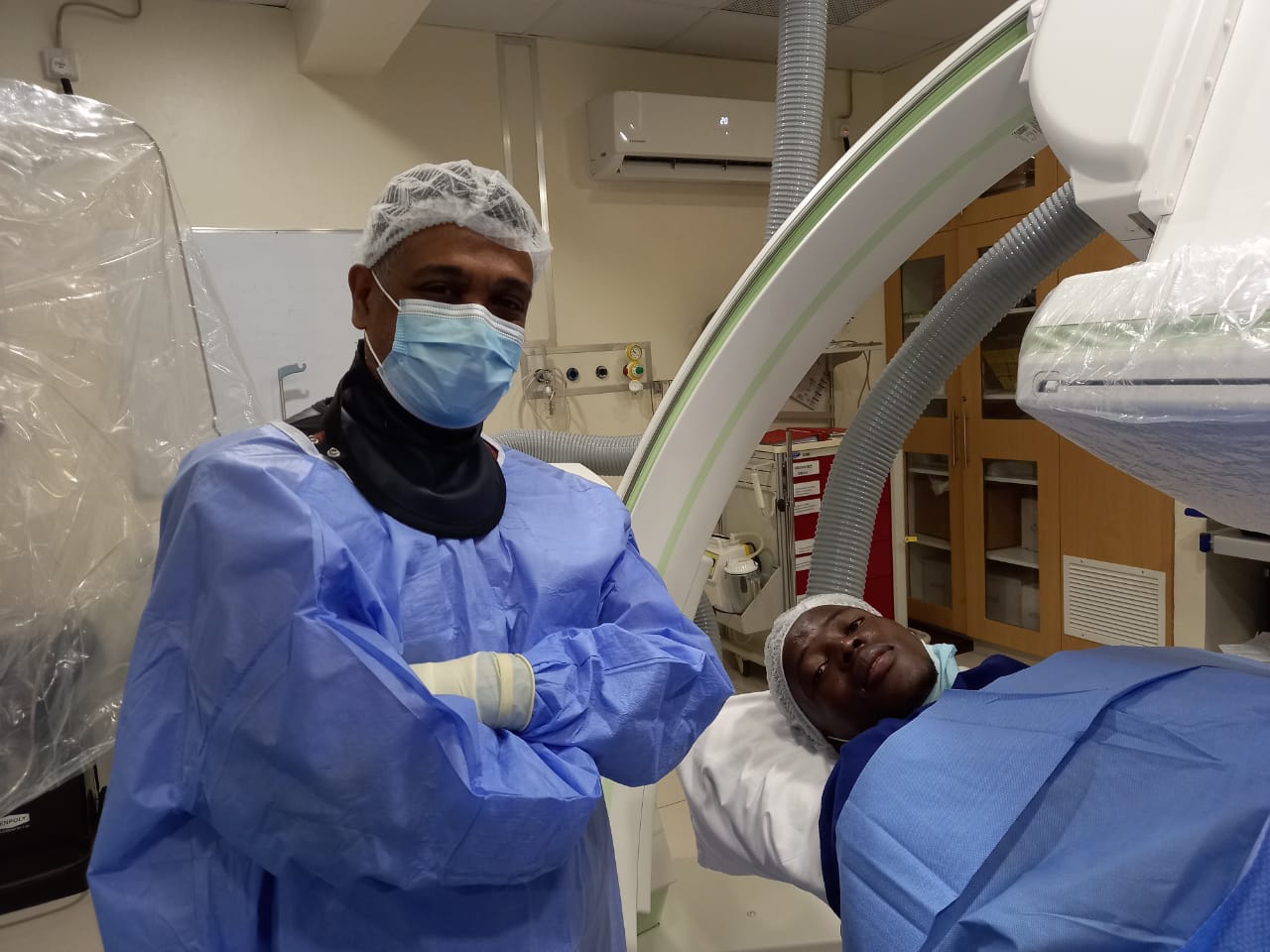 Wamalwa in the operating room.
For a while, the predicament engulfed them in their dark tunnel, hope seeming like a foreign term in their attempts to find a solution.
But as James 5:16 narrates how the fervent prayers of a faithful man availeth much, Wamalwa kept the faith that they would find a breakthrough to their troubles.
“The situation had already happened. There was nothing we could do about it other than accept. It was a hard time but I firmly believed that if things were meant to go that way there was nothing I could do about it,” Wamalwa says.
Eventually, like a miracle, help knocked on the doors of Wamalwa. The very institutions that introduced him to the game, Rugby Patrons Society and Runda Rugby, came together to raise funds for his correctional procedure.
Dala 7s Team Of The Tournament
— Kenya Rugby (@OfficialKRU) July 3, 2022
Denis Abukuse (Menengai Oilers)
Leonard Mugaisi (Homeboyz)
Amos Onyinkwa (Menengai Oilers)
Mike Nyakundi ( Homeboyz)
Mark Kwemoi (Menengai Oilers)
Harmony Wamalwa (Homeboyz)
Beldad Ogeta ( Menengai Oilers)#NSC2022#Dala7s
Even strangers in the form of the doctors who conducted the operation, came to Wamalwa’s rescue. Something that the youngster fails to understand how it became possible.
“God came through for me through the Rugby Patrons Society and Carol Llyld (Sponsor Runda Rugby) who came together to fundraise the amount needed. Even the doctors, Dr. Shawish Mohammed (Aga Khan Mombasa) and Dr. Washo (Aga Khan Nairobi), contributed to pay for the surgery yet they did not even know me,” Wamalwa states.
After two weeks, Wamalwa was finally wheeled into the operation room for his surgery that was done at Aga Khan Mombasa. He narrates how he was scared about the unknown that lay ahead. How his hand was shaking uncontrollably when presented with the informed consent form he needed to sign prior to the surgery being done.
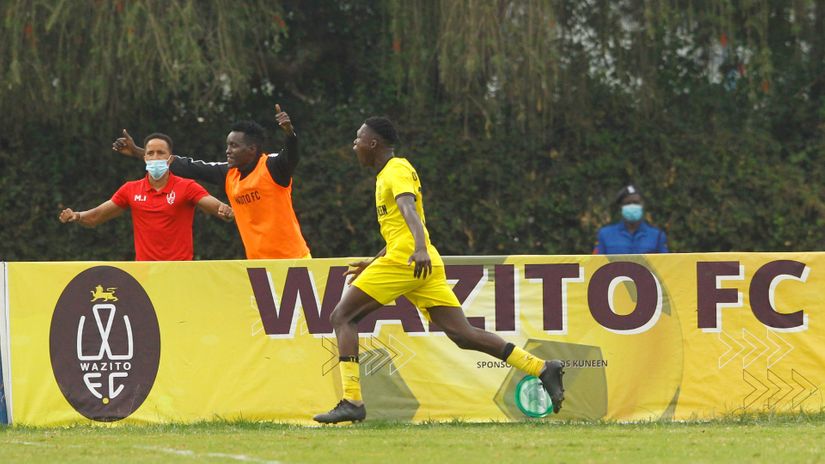
The surgery ended up being successful and it did not even take long for Wamalwa to make a return to the pitch. Three weeks after, the youngster started training to kind of start all over again.
Disappointingly, the ship that carried his debut for the country in the junior side had long gone because the tournament was already over.
The youngster however featured for the junior Chipu 7s side in the returning 2021 Safari 7s tournament where the team had been given an invite against the big boys in the invitational competition.
#NewProfilePic pic.twitter.com/mPPEFQB0Yz
— Amon Wamalwa (@wamalwa_amon) December 10, 2021
While a lot of people believe that whatever is meant for you will surely find its way to you, Wamalwa found the truth in the statement first hand.
The Safari 7s tournament marked a breakthrough time for him as the then Shujaa head coach Innocent ‘Namcos’ Simiyu spotted Wamalwa and invited him to train with the senior side, the major point that kick started Wamalwa’s journey to earning his senior debut after his major disappointment.
“I got an invite to train with the main team after playing with Chipu at the Safari 7s,” Wamalwa narrates.
Head Coach @isimiyu has handed youngster Amon Wamalwa his debut as he named the @kenyasevens squad for this weekend's #RugbyAfrica7s in Kampala, Uganda pic.twitter.com/xA2XPpKGW3
— Kenya Rugby (@OfficialKRU) April 21, 2022
“I did a lot of hard work and put in a lot of prayer. I was also very excited. All my life I had dreamt of such a moment, so getting it especially after what happened to me made me very happy,” he remarks after being named for the first time in the Shujaa squad that played in the 2022 Rugby Africa Men’s 7s Cup – a qualifying tournament for the 2022 Rugby World Cup Sevens.
In that whole tournament, a shambolic Shujaa had been exposed throughout. After emerging out of the group stage only in second place, having just narrowly survived courtesy of a superior points difference, Shujaa lost to eternal rivals Uganda in the semis leaving them with no other option but to beat Zambia in the 3/4th place playoff if they were to qualify.
“We were fighting for number three against Zambia because it was not such a good performance from us. Every team wanted to prove a point with us seeing that we feature on the HSBC World Rugby Sevens Series Circuit.

There was no way we were going to miss out on a World Cup slot. We kept on encouraging ourselves to just get over the line in that crucial 3/4th playoff match,” the youngster recollects.
In that match, the godsend Wamalwa ended up scoring two of the three tries that sent Kenya through to a sixth consecutive World Cup appearance as Shujaa picked a 19-12 victory.
Through it all, Wamalwa lived his dream of donning the national team jersey as he contributed in carrying the team to a sixth consecutive rugby 7s World Cup appearance.
“I always call and see myself as a dream chaser. And I do not know how to give up. So, I kept on telling myself that after all those setbacks I have been through in my life, I only need one chance to prove myself. That was all that was going through my head after the Uganda experience,” he says.
Top point scorer, top scorer christie7s
— Amon Wamalwa (@wamalwa_amon) May 30, 2022
Homeboyz Rugby thank you🙏💙💛
Onwards and upwards pic.twitter.com/gXoMBqATm0
At the end of the day, a confident Wamalwa reveals what his ultimate goal in the sport is.
“As a player, I would love to be remembered in the HSBC Circuit as someone who helped his team win matches like Collins Injera. It is also every sportsman’s dream to feature at the Olympic Games. So my dream is to become an Olympian,” he concludes.
Who says a heart condition has to put you down?