


TACTICAL ANALYSIS: Algeria's Positional Brilliance Undone by Swiss Efficiency





Reading Time: 6min | Sat. 04.07.26. | 14:01
Switzerland's awaited knockout victory was therefore built not on overwhelming control but on superior game management, defensive organisation and ruthless exploitation of the spaces Algeria repeatedly left exposed.
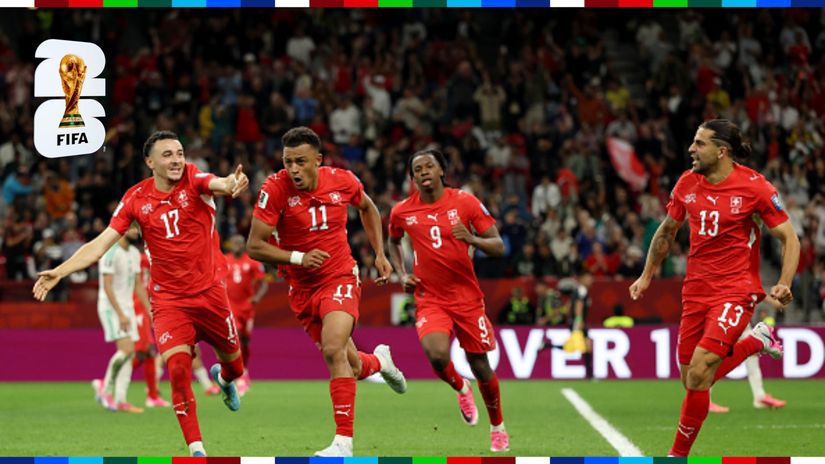
Switzerland booked their place in the FIFA World Cup Round of 16 with a composed 2-0 victory over Algeria, ending an 88-year wait for a knockout-stage win in the competition.
Download our MozzartSport App For More News
Goals from Breel Embolo and Dan Ndoye either side of half-time rewarded an efficient rather than dominant Swiss performance, while Johan Manzambi once again underlined why he has become one of the breakout stars of the tournament.
Although Algeria controlled long periods of possession and displayed impressive positional fluidity, Switzerland consistently exploited the spaces left behind by their aggressive attacking structure before defending their advantage with remarkable organisation.
Switzerland started in a 4-2-3-1 with Gregor Kobel in goal behind a back four of Denis Zakaria, Nico Elvedi, Manuel Akanji and Ricardo Rodríguez.
Granit Xhaka partnered Remo Freuler at the base of midfield, while Dan Ndoye and Ruben Vargas occupied the flanks around Johan Manzambi, who operated as the attacking midfielder behind Breel Embolo.
.jpg)
Out of possession they alternated between a compact 4-5-1 mid-block and a narrow 4-4-2 diamond, often with Xhaka stepping to the tip of the midfield diamond to help press Algeria's double pivot.
Algeria mirrored Switzerland's positional flexibility despite beginning from a nominal 4-3-3.
Lucas Zidane started in goal behind Rafik Belghali, Aïssa Mandi, Ramy Bensebaini and Rayan Aït-Nouri. Ramiz Zerrouki and Nabil Bentaleb operated as the deeper midfield pair, with Riyad Mahrez starting from the right, Fares Chaibi and Houssem Aouar attacking from the left-sided interior spaces and Ibrahim Maza functioning less as a traditional striker and more as a false nine.
In settled possession Algeria regularly transformed into expansive 3-1-6 or 2-2-6 structures, sacrificing central occupation to maximise width and overloads along the flanks.
Before Switzerland's opening goal, Algeria were arguably the better side.
Their first phase of build-up displayed considerable positional intelligence, with Bentaleb frequently dropping alongside the centre-backs to facilitate progression while Chaibi occasionally rotated as deep as left-back to maintain circulation.
These rotations constantly changed Switzerland's pressing references and allowed Algeria to dominate early possession. The spacing between their full-backs and wide attackers was particularly effective, with players occupying different vertical lines to stretch the Swiss defensive block horizontally while maintaining multiple passing angles through the thirds.
The left side became Algeria's primary attacking platform. Chaibi, Aouar and the advancing Aït-Nouri repeatedly combined to create numerical overloads against Switzerland's right side.
Rather than holding fixed positions, Chaibi drifted between the left half-space and deeper support zones, Aouar operated between the lines while Aït-Nouri aggressively overlapped to provide width.
With Maza dropping away from the centre-backs as a false nine, Algeria intentionally sacrificed a permanent penalty-box presence to overload midfield and sustain possession. Their combinations consistently progressed play into advanced areas, but they lacked one crucial element: vertical depth.
Too many Algerian attacks remained in front of Switzerland's defensive line.
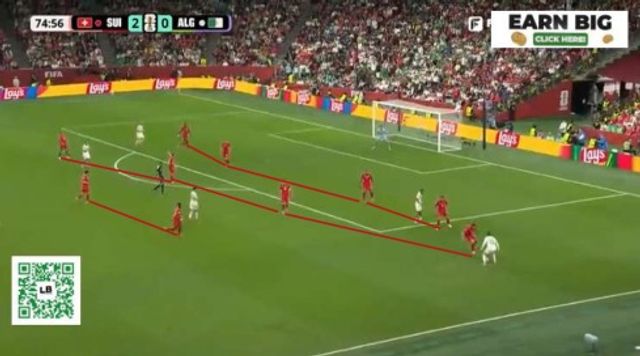
While the rotations successfully destabilised Switzerland's midfield shape, there were relatively few penetrating runs beyond the last line to stretch Manuel Akanji and Nico Elvedi.
Most forward passes were played into feet rather than into space, allowing Switzerland's back four to remain compact despite Algeria's territorial dominance. This inability to consistently threaten the space behind ultimately reduced the effectiveness of otherwise sophisticated possession sequences.
Switzerland, meanwhile, accepted long periods without the ball but looked considerably more dangerous whenever possession changed hands.
Their compact 4-5-1 and 4-4-2 defensive structures denied central access before springing quickly into transition.
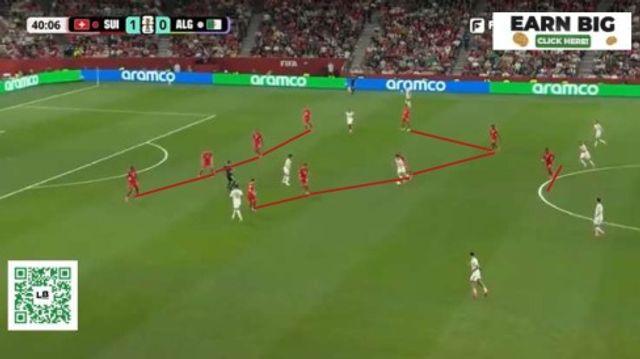
The opening goal perfectly illustrated this strategy. Algeria had committed Belghali high into the attacking phase, leaving significant space behind the advancing right-back.
Once possession was regained, Switzerland immediately attacked that exposed channel. Johan Manzambi drove into the vacated space, accelerated past Aïssa Mandi towards the byline and delivered an accurate cross for Embolo to finish.
It was Switzerland's first meaningful attack, but one entirely consistent with their tactical plan of exploiting Algeria's aggressive full-back positioning.
That vulnerability originated from Algeria's attacking rest-defence. Belghali was encouraged to advance aggressively because Zerrouki intelligently slid into the right-back position during attacking phases to provide balance.
While this rotation maintained numerical security during settled possession, it could not fully compensate once Switzerland broke beyond Algeria's first line of pressure. The distances became too large, allowing direct transitions into the channels before Algeria could reorganise their defensive structure.
Out of possession Algeria defended in a compact 4-4-2 mid-block that generally prevented Switzerland from constructing sustained attacks.
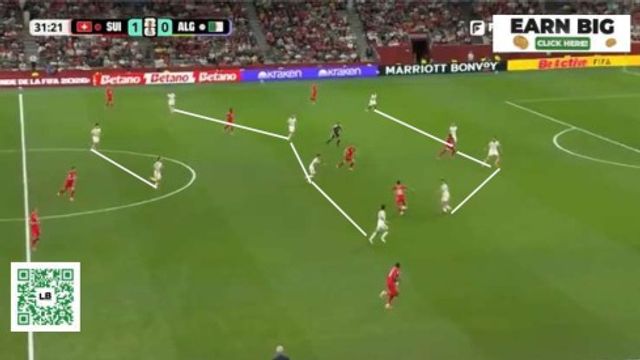
However, the same aggressive positioning that made them so effective with the ball occasionally left gaps between their midfield and defensive lines whenever Switzerland escaped the initial pressure.
Those moments became increasingly significant because Switzerland possessed direct runners in both wide areas. Ndoye and Vargas consistently attacked defenders one-versus-one rather than recycling possession, forcing Algeria's full-backs into uncomfortable defensive situations immediately after transitions.
Switzerland doubled their lead only 48 seconds after the second half restart through another moment that reflected the importance of transitions. Algeria twice failed to clear their penalty area following Zakaria's interception, allowing Ndoye to calmly finish from just inside the box.
Unlike the opening goal, this strike stemmed less from structured attacking play and more from Algeria's inability to recover defensive organisation after losing possession in dangerous territory.
Trailing by two goals, Algeria adjusted both their personnel and tactical approach a minute just before the hour mark.
Amine Gouiri replaced Zerrouki to provide a recognised centre-forward, while Jaouen Hadjam entered at left-back.
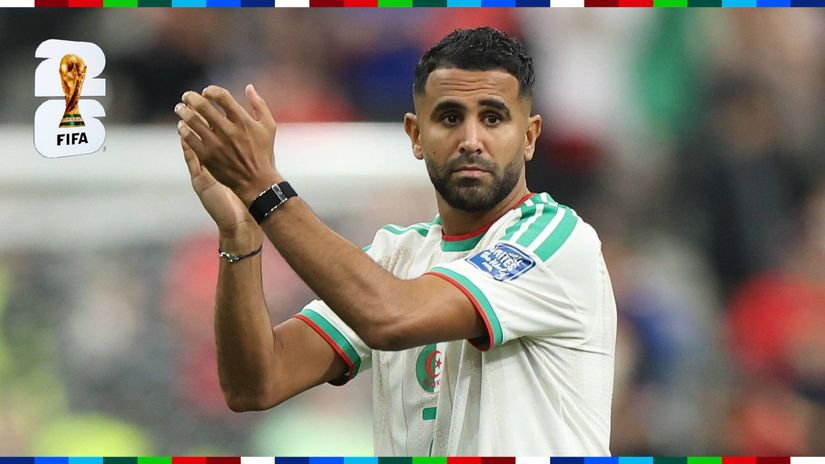
These substitutions triggered a broader structural reshuffle. Aït-Nouri advanced into the left wing, Chaibi dropped alongside Bentaleb in midfield,
Maza shifted into the attacking midfield role and Gouiri occupied the central striking position.
The changes finally gave Algeria greater penalty-box presence while preserving their technical quality between the lines.
Their approach without possession also became significantly more aggressive.
Algeria abandoned much of their compact mid-block in favour of an assertive man-oriented high press designed to disrupt Switzerland's build-up at source. Individual players locked onto direct opponents across the pitch, seeking to force rushed clearances and create immediate attacking opportunities from regains high up the field.
However, Switzerland adapted intelligently. Rather than forcing risky passes through tightly marked teammates, Freuler repeatedly dropped alongside Xhaka to create an additional passing option underneath the first pressing line.
His movement produced temporary numerical superiority during the build-up, making him the free player whenever Algeria's front line committed to man-marking.
Once Freuler received possession, Switzerland could progress beyond the initial press before exploiting the spaces left by Algeria's advanced defensive line. It was a subtle but decisive adjustment that prevented Algeria's tactical gamble from generating sustained pressure.
Without the ball, Switzerland maintained impressive discipline throughout the second half. Their compact defensive block protected central spaces while forcing Algeria towards wider areas where crossing opportunities were easier to defend.
Zakaria epitomised that organisation with an outstanding recovery block to deny Mahrez, while Xhaka's leadership extended beyond his landmark 150th international appearance.
The captain finished with team-high figures for duels won (10), possessions regained (eight) and fouls won (five), illustrating his influence in controlling transitions and protecting Switzerland's defensive structure.
Although Algeria enjoyed considerable possession and displayed encouraging positional principles, the underlying numbers reflected Switzerland's greater efficiency in decisive moments.

Switzerland generated 2.52 expected goals from 11 shots compared to Algeria's 0.73 xG from eight attempts, highlighting the superior quality of their opportunities despite enjoying less of the ball.
Algeria's intricate circulation frequently reached advanced positions but rarely translated into clear chances because Switzerland consistently protected the central spaces in front of goal.
Ultimately, this was a contest decided by structural efficiency rather than territorial dominance.