


.jpeg)
TACTICAL ANALYSIS: How Al Ahly dismantled Duke Abuya's Yanga in CAF CL


.jpg)
Reading Time: 7min | Mon. 26.01.26. | 18:21
This analysis delves into the structural foundations, defensive schemes, build-up patterns, and adjustments that defined the game
In a gripping encounter that underscored Al Ahly's dominance, the Egyptian giants secured a convincing 2-0 victory over Tanzania's Young Africans (Yanga).
Follow our WhatsApp channel for more news
This match, part of the CAF Champions League group stage, carried significant stakes for both sides: Al Ahly aiming to solidify their position at the top, while Yanga sought a statement result against one of the continent's powerhouses.
Mahmoud Trezeguet emerged as the hero with a brace, but the scoreline belied a contest shaped by tactical nuance rather than individual brilliance.
Al Ahly's superior possession and pressing overwhelmed Yanga's disciplined setup, leading to a one-sided affair after the interval.
This analysis delves into the structural foundations, defensive schemes, build-up patterns, and adjustments that defined the game, revealing how Al Ahly exploited Yanga's vulnerabilities to claim all three points.

From the outset, both teams established clear base shapes that set the tone for their respective approaches.
Al Ahly lined up in a fluid 4-3-3 that seamlessly transitioned into a 3-2-5 during build-up phases.
Mostafa Shobeir guarded the goal, with Mohamed Hany at right-back pushing adventurously forward, often leaving a back three comprising Yasser Ahmed, Yassin Mostafa, and Koka Ahmed Nabil.
In midfield, Marwan Attia and Aliou Dieng formed a double pivot, providing stability, while Emam Ashour operated as a roaming No. 10, drifting between the lines and occasionally joining the forward line.
Ahmed Sayed Zizo occupied the right wing with flexible movements, dropping deep or inverting as needed, Marwan Othman led the line as the central striker, and Mahmoud Trezeguet terrorized from the left flank.
Yanga, meanwhile, adopted a more conservative 4-3-3 structure, with
Djigui Diarra in goal, Israel Mwenda at right-back, Ibrahim Abdullah at left-back, and Bakari Mwamnyeto paired with Dickson Job in central defense.
Duke Abuya anchored midfield alongside Damaro Mohamed, Max Nzengeli pushed forward as the advanced midfielder, Allan Okello started on the right wing,
Boka Chadrack on the left, and Depu Laurindo as the nominal striker. These formations served as frameworks for dynamic behaviors, with Al Ahly's shape emphasizing overloads and Yanga's focusing on compactness to absorb pressure.
Before dissecting Al Ahly's attacking prowess, it's essential to understand Yanga's defensive scheme, which formed the backbone of their resistance but ultimately proved their undoing.
Yanga employed a man-oriented mid-block, often shifting into a 5-4-1 or 5-2-3 out of possession to maintain discipline against Al Ahly's possession dominance.
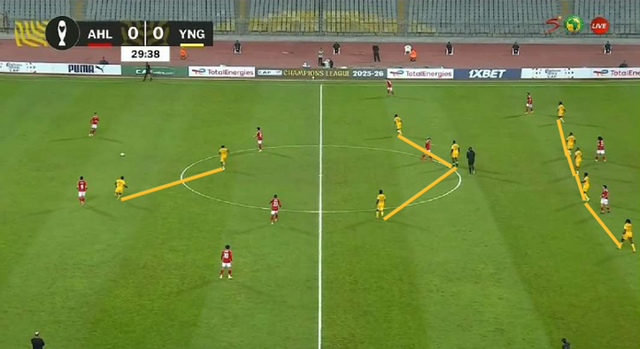
This approach prioritized individual matchups, with wingers like Boka Chadrack tracking opponents such as Zizo deep into their own half, and the full-backs - particularly Ibrahim on the left centre back position- pushing high to compress space
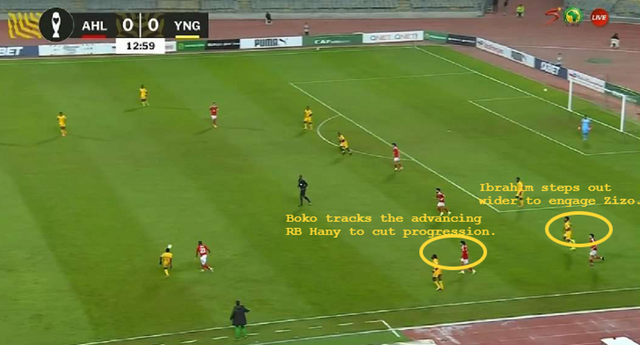
The central defenders, Mwamnyeto and Job, aimed for compactness in the middle, using an offside trap to catch Al Ahly's forwards like Trezeguet and Othman straying too far forward.
However, this man-orientation left gaps when players were pulled out of position, especially in central areas, and the high defensive line invited exploitation behind.
Yanga's block was mid-height, neither aggressively high nor overly deep, allowing them to counter quickly but exposing them to precise through balls. This setup worked initially to frustrate Al Ahly, but as the game progressed, it created dilemmas: commit to marking and risk isolation, or drop deeper and cede territory.
Al Ahly's build-up structure was a model of rotational ingenuity, designed to probe and stretch Yanga's man-marking.
Starting from the back, the Egyptians circulated patiently, with Dieng often dropping deep alongside Attia to form a temporary double pivot overload in midfield, drawing Yanga's pressers forward and creating 3v2 advantages centrally.
This allowed quick switches to the flanks, where Hany's overlapping runs from right-back inverted the shape, pulling Yanga's left-back Abdullah wide and opening inside channels for Zizo or Ashour.
Othman frequently dropped from his striker role into deeper positions, luring Yanga's center-backs out and disrupting their compactness, which in turn freed space for Trezeguet to make diagonal runs.

These rotations weren't arbitrary; they forced Yanga's defenders into constant decision-making - follow the drop and leave gaps behind, or stay put and allow free reception between the lines.
By the 20th minute, this mechanism was evident, as Al Ahly shifted the ball wide to exploit Mwenda's high positioning, creating numerical superiority on the flanks before recycling possession inward.
The core of Al Ahly's success lay in exploiting Yanga's structural weaknesses, particularly their over-reliance on man-orientation and the vulnerabilities of their high line.
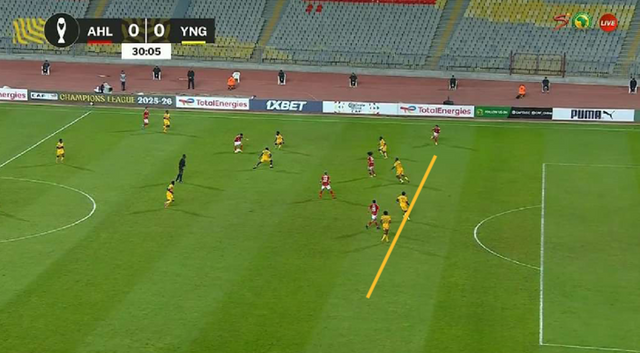
Yanga's commitment to individual marking meant that clever movements, like Othman's deep drops, dragged center-backs like Job out of sync, exposing the backline to runs in behind.
Al Ahly punished this repeatedly: in the 39th minute, Othman's drop lured defenders forward then he received from Zizo’s pass, allowing him eventually to thread a pass to Trezeguet, whose run to the ball was well managed by Diarra's heroics off his line.
The offside trap, another key element of Yanga's defense, was neutralized by Al Ahly's timed runs and positional awareness, with players like Ashour holding positions to pin markers.
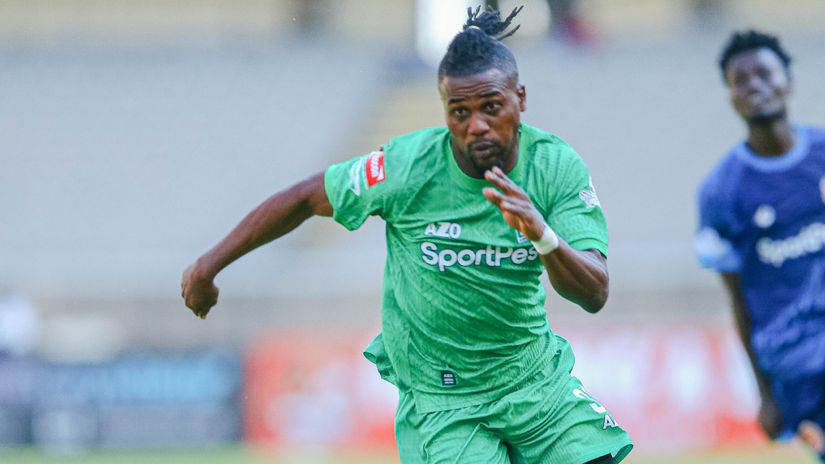
Goals served as perfect illustrations - the opener in first-half added time came from Hany's early cross exploiting Mwenda's advanced position, with Trezeguet outjumping the right-back for a towering header.
In the second half, the second goal stemmed from Ashour's through ball slicing through the high line, finding Trezeguet in the box for a composed finish.
These moments weren't isolated; they stemmed from systemic exploitation, where Al Ahly's rotations created mismatches that Yanga's rigid marking couldn't adapt to swiftly.
Domination in key zones, such as the inside channels, further tilted the game in Al Ahly's favor.
Zone 14 - the central area just outside the penalty box - became a hub for Al Ahly's creativity, with Ashour's intelligence allowing him to receive freely between Yanga's midfield and defensive lines.
Yanga's man-orientation prioritized wide protection, often leaving central spaces under-defended as wingers tracked back, which exposed half-spaces for Al Ahly's inverted wingers like Zizo.
On the right, positional rotations involving Hany, Zizo, and Dieng's forward ventures pulled Yanga's left side apart, creating channels for inside runs.
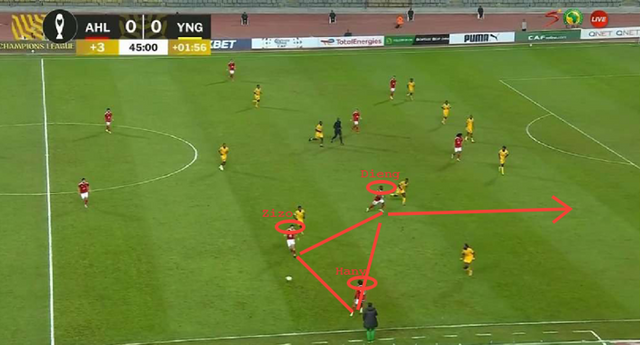
This zonal control generated high-quality chances: Al Ahly's possession dominance (implied by their probing) stemmed from occupying these areas, forcing Yanga into reactive mode.
The Egyptians' ability to access these zones wasn't luck; it resulted from build-up patterns that stretched Yanga's block horizontally, then vertically, leaving defenders isolated and unable to cover multiple threats.
Al Ahly's pressing and build-up disruption were instrumental in maintaining control, suffocating Yanga's attempts to play out.
The Egyptians pressed in a high man-oriented fashion from the front, morphing into a 4-4-2 shape out of possession, with the front two leading the charge to prevent Yanga's circulation from the back.
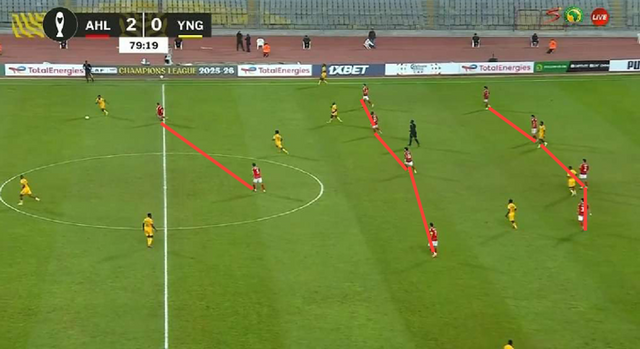
Triggers included wide passes, prompting Nzengeli or Boka to jump on the ball, but Al Ahly countered this by curving runs to trap on the flanks and force long balls.
This directionality - guiding the ball wide before closing in - led to turnovers and second-ball wins, as Al Ahly's midfield pivots like Attia dropped to sweep up.
Yanga's long restarts, especially in the second half, were neutralized, turning potential counters into Al Ahly regains. The press wasn't just aggressive; it was intelligent, exploiting Yanga's preference for direct balls to Depu, which Al Ahly's high line intercepted effectively.
Equally vital was Al Ahly's rest-defense and counterpressure, which stifled Yanga's transitions.
Even in attacking phases, Al Ahly maintained a compact structure behind the ball, with Dieng and Attia positioned to counterpress immediately upon loss, preventing Yanga from breaking quickly through Nzengeli or Okello.
This occupational awareness - players like Hany recovering swiftly after forward ventures - ensured numerical superiority in midfield during turnovers, killing counters at source.
Yanga's dangerous breaks in the first half, via long balls to Depu and Okello, fizzled because Al Ahly's rest-defense funneled play into crowded areas, regaining possession high up the pitch.
The game evolved through tactical adjustments, particularly in the second half, altering the dynamics.
Yanga shifted to a more aggressive 4-3-3, with Mwenda charging higher and Okello switching wings, introducing urgency via substitutions like Mudathir Yahya and Pacome Zouzoua around the 57th minute.
This created passing triangles in progression, with a 4-4-2 mid-block out of possession evolving into a 4-1-4-1 for higher pressing.
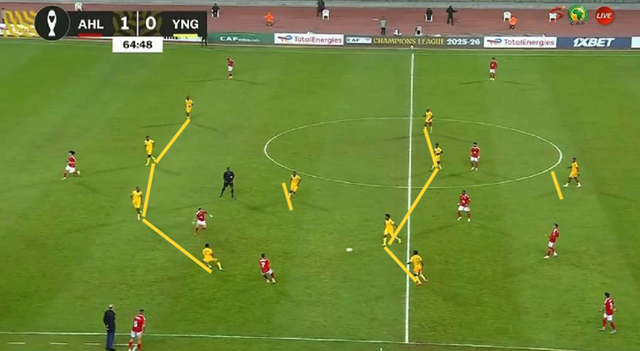
Benefits included better counterpressing and overloads on the left via Zouzoua and Boka, but trade-offs emerged: the higher line exposed spaces behind, which Al Ahly targeted with runners. Al Ahly responded with their own change, replacing Othman with Gradisar in the 65th minute to refresh the forward line, maintaining a 4-4-2 mid-block to absorb Yanga's probes.
These shifts heightened the intensity, but Al Ahly's adaptability - exploiting the new gaps - sealed the win with Trezeguet's second goal.
Even as the dominant side, Al Ahly's defensive phase without the ball showcased their completeness.
Dropping into a compact mid-block when needed, they triggered steps forward on loose balls, with recovery runs from wingers like Trezeguet ensuring solidity.
This phase prevented Yanga from capitalizing on left-wing overloads late on, with clean defending maintaining the clean sheet.
In conclusion, Al Ahly's tactical superiority - rooted in rotational build-up, zonal exploitation, and relentless pressing - overwhelmed Yanga's resilient but flawed man-oriented setup.
While Yanga showed promise in counters and adjustments, their structural weaknesses, like the high line and marking rigidity, were ruthlessly punished.
This victory reinforces Al Ahly's status as CAF contenders, exposing Yanga's need for defensive flexibility in big games. Tactically, it was a clinic in exploiting mismatches, with Al Ahly's cohesion proving decisive.