



TACTICAL ANALYSIS: How Orlando Pirates edged Orbit College to end 14-year league title drought




Reading Time: 6min | Mon. 25.05.26. | 21:04
Pirates consistently imposed themselves territorially and structurally against an Orbit College side that defended bravely for large spells.
Orlando Pirates secured a decisive 2-0 victory over Orbit College to clinch the South African Premiership title after 14 years without lifting the league crown.
Download our Mozzart Sport app for more news
From their aggressive pressing scheme and dynamic wing overloads to their disciplined rest-defence structure, Pirates consistently imposed themselves territorially and structurally against an Orbit College side that defended bravely for large spells.
Orbit College began the match in a 4-3-3 structure. Sabelo Nkomo started in goal behind a back four of Kobameli Setlhodi, Ngiba Ndumiso, Karabo Mngeshane, and Samukele Mkhize.
The midfield trio consisted of Disemelo Reotophile, Axolile Noyo, and Realeboga Potsana, while Mbulelo Wagaba operated from the right wing, Kgotso Masangane occupied central attacking zones, and Lethabo Modimoeng provided width on the opposite flank.
Orlando Pirates, meanwhile, lined up in a fluid 4-2-3-1 system. Sipho Chaine started in goal, with Sibelebele and Ndaba Nkhosikhona operating as highly aggressive attacking fullbacks.

Lebone Seema and Nkosinathi Sibisi formed the central defensive partnership, while Simphiwe Selepe and Thalente Mbatha controlled midfield. Relebohile Mofokeng operated as the advanced playmaker, drifting freely between the lines and into half-spaces.
Oswin Appollis started on the right wing, Tshepang Moremi on the left, and Yanela Mbuthuma led the line.
Orbit College’s defensive approach was one of the key tactical foundations of the match. Out of possession, they initially pressed in a high 4-2-3-1 shape before retreating into a compact 5-4-1 low block during deeper defensive phases.
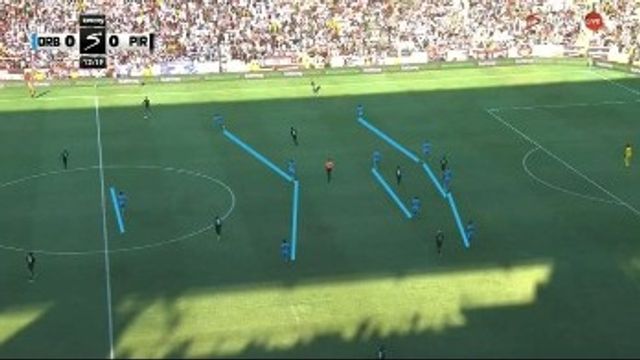
Their intention was clear: congest central zones, limit Pirates' forwards' freedom between the lines, and force them into wider areas.
The back line remained narrow for most of the first half, with the wide midfielders dropping aggressively to support the fullbacks whenever Pirates attempted to isolate wingers in one-versus-one situations.
However, Pirates anticipated this compactness and immediately looked to stretch Orbit horizontally.
Their early attacking patterns focused heavily on creating overloads on one flank before quickly switching play or attacking the depth behind Orbit’s defensive line.
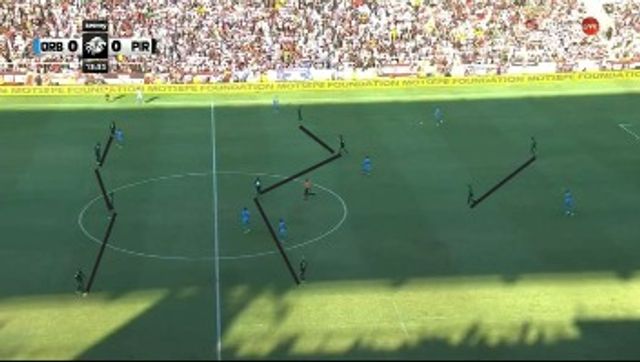
The positioning of the fullbacks was particularly important. Sibelebele and Ndaba stayed extremely high(refer to the illustration below), often joining the front line and functioning almost as auxiliary wingers during sustained attacks.
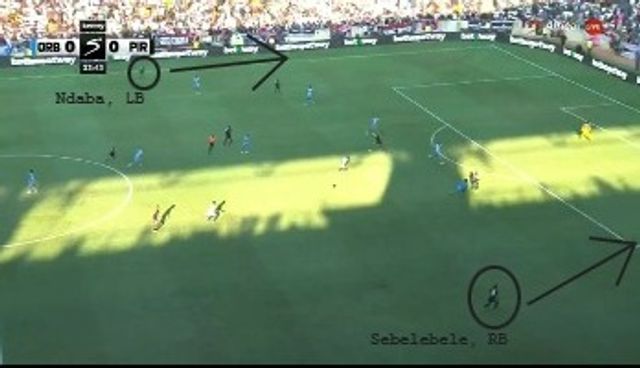
Their advanced positioning pinned Orbit’s wide players deeper and prevented them from supporting transitions effectively.
Pirates also manipulated Orbit’s defensive shape through midfield width. Rather than keeping both holding midfielders centrally, one midfielder frequently drifted wider to create additional passing angles and isolate Orbit’s wide defenders.
This created repeated situations where Appollis or Moremi could receive in space against a retreating defensive line. The attacking rotations in the front four further destabilised Orbit’s marking references.
Mofokeng constantly drifted into half-spaces, while Appollis occasionally dropped deeper into midfield zones to function as a temporary playmaker.
Around the 13th-minute mark, Appollis’ deeper movements became increasingly influential. By dropping into midfield, he dragged Orbit’s midfield line out of shape and opened passing lanes into runners attacking the space behind the defence.
Pirates used these movements not merely for possession circulation, but to force decision-making dilemmas on Orbit’s defenders.
If Orbit’s midfield tracked Appollis inward, space opened wide. If they held shape, Appollis gained time to pick vertical passes into dangerous areas for Mbuthuma’s runs.

Without the ball, Pirates displayed one of their strongest tactical features: their aggressive high press combined with an organised rest-defence structure.
Whenever Orbit attempted to build short from the back, Pirates immediately closed central passing lanes and pressed with intensity around the ball carrier.
The front four pressed aggressively while the midfield stepped high to deny interior progression. Importantly, the pressing was not chaotic. Pirates used curved pressing runs to direct Orbit toward the flanks, where pressing traps could be activated near the touchline.
This approach had two benefits. First, it generated quick turnovers in advanced areas, allowing Pirates to immediately attack Orbit’s penalty area during moments of defensive disorganisation.
Second, it prevented Orbit from sustaining possession through central zones. Even when Orbit escaped the first line of pressure, Pirates’ midfield recovery runs and compactness behind the ball ensured that dangerous transitions rarely developed.
Their rest-defence structure was equally impressive.

Despite committing both fullbacks high in possession, Pirates maintained balance behind attacks.
The two central defenders stayed connected while Selepe and Mbatha constantly adjusted their positioning to protect central transition zones. The wingers also contributed defensively through aggressive recovery runs.
When Pirates lost possession, they could quickly collapse into a compact 4-4-2 midblock, limiting Orbit’s ability to exploit the spaces left behind by the advanced fullbacks.
Orbit College nevertheless defended admirably throughout much of the first half. Their compactness around the penalty area frustrated Pirates, who enjoyed territorial dominance but struggled to convert possession into clear-cut chances.
Orbit nearly punished Pirates from a set-piece in the 43rd minute when Sipho Chaine misjudged a corner delivery, but the final touch narrowly missed the target.
The breakthrough finally arrived in first-half stoppage time. Significantly, the goal emerged from another phase where Pirates had sustained pressure deep inside Orbit's territory.
Tshepang Moremi delivered an inswinging corner that forced uncertainty inside the six-yard box, and under pressure, goalkeeper Nkomo punched the ball into his own net. While officially an own goal, the sequence reflected Pirates’ territorial dominance and consistent ability to sustain attacking pressure around Orbit’s penalty area.
The second half began with Pirates immediately intensifying their vertical threat. Just three minutes after the restart, they doubled their lead through another situation created by depth exploitation.
Mbatha, dropping deep (situationally alongside the centre-backs during build-up - refer to the illustration below), delivered a perfectly weighted pass over Orbit’s defensive line.
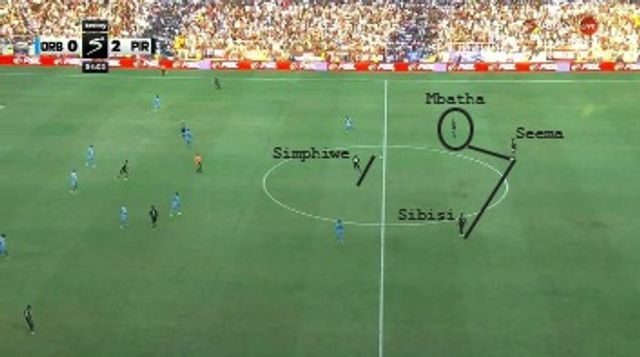
The resulting chaos forced Ngiba into an own goal after the goalkeeper rushed off his line. Again, the tactical principle was clear: attack the space behind Orbit’s defensive structure before the defensive line could recover.
Orbit attempted to adapt by bypassing Pirates’ high press through direct long balls from restarts.
However, this adjustment created new problems. By going long early, Orbit frequently surrendered possession and lost the ability to establish controlled attacks. Pirates dominated second balls and regained territorial control quickly after turnovers.
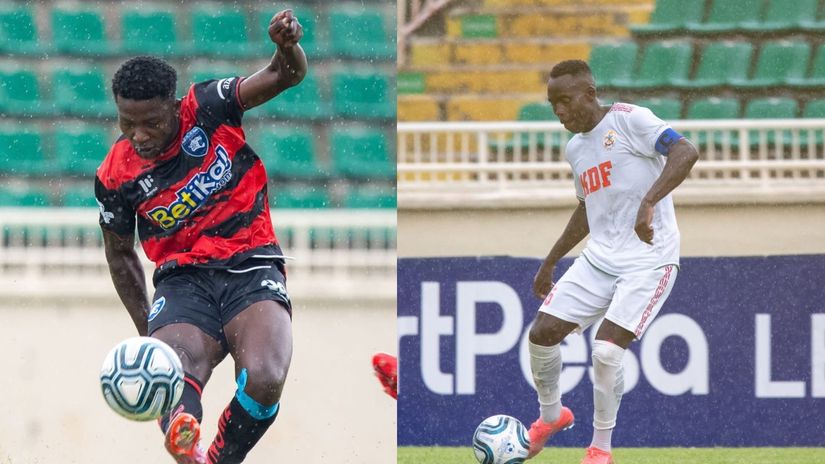
The introduction of five substitutes around the 55th minute briefly improved Orbit’s attacking width, particularly down the left side through Khoto.
Orbit began finding occasional spaces behind Pirates’ advanced fullbacks, forcing a slight tactical recalibration from the champions. Between the 55th and 65th minute, Pirates reduced the attacking aggression of their fullbacks and prioritised defensive compactness instead.
Pirates’ substitutions also reflected strong game-state management. Patrick Masagwanyi’s introduction after the withdrawal of Moremi altered midfield dynamics, allowing Mofokeng to drift wider on the left while adding fresh control centrally.
Later changes involving Abdullaye Mariko and Evidence Makgopa maintained physical intensity in attacking transitions while preserving structural discipline in the midfield department.
As the match progressed, Pirates increasingly relied on intricate passing combinations and third-man movements around the penalty area. Rather than forcing direct attacks, they controlled tempo intelligently, circulating possession and waiting for openings to emerge.
Sibelebele’s late overlapping runs from right-back remained a recurring weapon, particularly when fed by Masagwanyi’s progressive passing from deeper midfield positions.
Ultimately, this was a performance built on tactical maturity and structural superiority. Pirates controlled wide areas, manipulated Orbit’s defensive compactness, and dominated transitions through coordinated pressing and rest-defence.
Orbit College showed admirable organisation and discipline for long stretches, but Pirates’ superior positional play, attacking rotations, and game management eventually proved decisive.
After 14 years without a league title, Orlando Pirates secured the Premiership crown through a display that reflected not only technical quality, but also tactical cohesion across every phase of the game.